



The B2B Marketing Model Confusion
Demand generation, growth marketing, and account-based marketing (ABM) are not competing philosophies—they are overlapping strategies that address different pipeline challenges. The confusion arises when organizations treat them as mutually exclusive and force teams to choose one over the other.
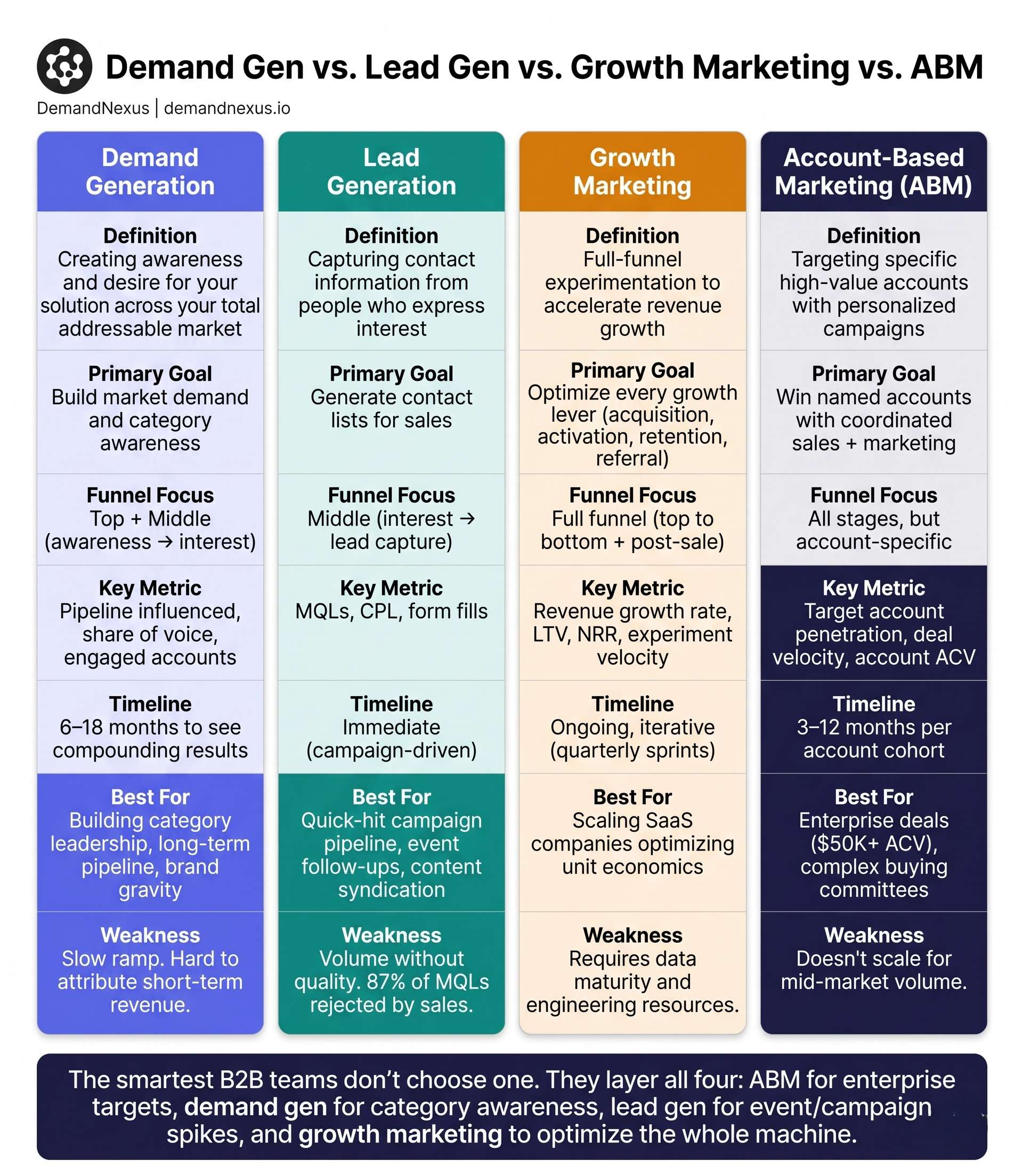
The practical truth: the best B2B programs in 2026 layer all three. Demand generation creates awareness and pipeline across the total addressable market. ABM focuses that pipeline on high-value target accounts. Growth marketing optimizes the entire funnel—including expansion and retention—for revenue efficiency.

Most B2B teams lose 40–60% of qualified prospects to broken handoffs and weak qualification. Take our 2-minute diagnostic to find out where your pipeline is bleeding — and how to fix it.
Start the Quiz → Takes 2 minutes. No email required to start.Understanding where each model excels helps you allocate resources appropriately.
Demand Generation: Creating Pipeline at Scale
Demand generation focuses on creating awareness and qualified interest across your entire ICP. It is the broadest of the three models and answers the question: how do we get more qualified buyers into our pipeline?
Strengths: Scales pipeline creation across verticals and segments. Builds brand authority through educational content. Generates first-party intent data. Delivers predictable monthly appointment volume.

Best for: Companies expanding into new markets, organizations that need steady pipeline flow, and teams that want to fill the top and middle of their funnel with qualified opportunities.

The key differentiator in 2026: demand generation programs powered by proprietary first-party intent data from niche media brands outperform those relying on paid advertising or third-party data. First-party signals deliver 70-80% qualification rates compared to 30-50% from traditional channels.
Account-Based Marketing: Precision for High-Value Targets
ABM flips the funnel by starting with a defined list of target accounts and engineering personalized campaigns for each. It answers the question: how do we win specific high-value accounts?
Strengths: Deep personalization for enterprise deals. Multi-threaded engagement across buying committees. Shorter sales cycles for targeted accounts.
Best for: Enterprise sales with $100K+ deal sizes, organizations with defined target account lists, and teams that need to coordinate marketing and sales efforts around specific accounts.
Limitation: ABM does not scale efficiently for broad market coverage. If you need 50+ new opportunities per month across diverse segments, ABM alone will not deliver.
Growth Marketing: Full-Funnel Revenue Optimization
Growth marketing encompasses the entire customer lifecycle—from acquisition through expansion and retention. It answers the question: how do we maximize revenue per customer?
Strengths: Optimizes full-funnel conversion. Includes product-led growth motions. Focuses on unit economics and customer lifetime value.
Best for: SaaS companies with self-serve or freemium products, organizations focused on net revenue retention, and teams optimizing for efficiency rather than pure pipeline growth.
Limitation: Growth marketing without strong demand generation is optimizing a funnel that may not have enough qualified inputs. You cannot optimize conversion rates on a pipeline you have not built.
Demand Capture vs. Demand Generation: The Missing Distinction
One important distinction often missing from these comparisons is demand capture versus demand generation. Demand capture targets buyers who are already looking for your solution category (search ads, review sites, comparison content). Demand generation creates awareness among buyers who do not yet know they have a problem—or that solutions exist.
Most companies over-invest in demand capture and under-invest in demand generation. The result: they compete fiercely for the 3-5% of the market actively searching, while ignoring the 95-97% who could become future buyers with the right education and nurturing.
The Combined Model: How to Layer All Three
The highest-performing B2B organizations in 2026 use all three models simultaneously:
Demand Generation: Builds broad awareness and generates 15+ qualified appointments per month through first-party intent data, content syndication, and multi-channel campaigns.
ABM: Overlays target account prioritization on top of demand generation, ensuring that the highest-value accounts receive personalized, multi-threaded engagement.
Growth Marketing: Optimizes the full funnel—from initial qualification through close to expansion—ensuring that demand generation and ABM-sourced customers deliver maximum lifetime value.
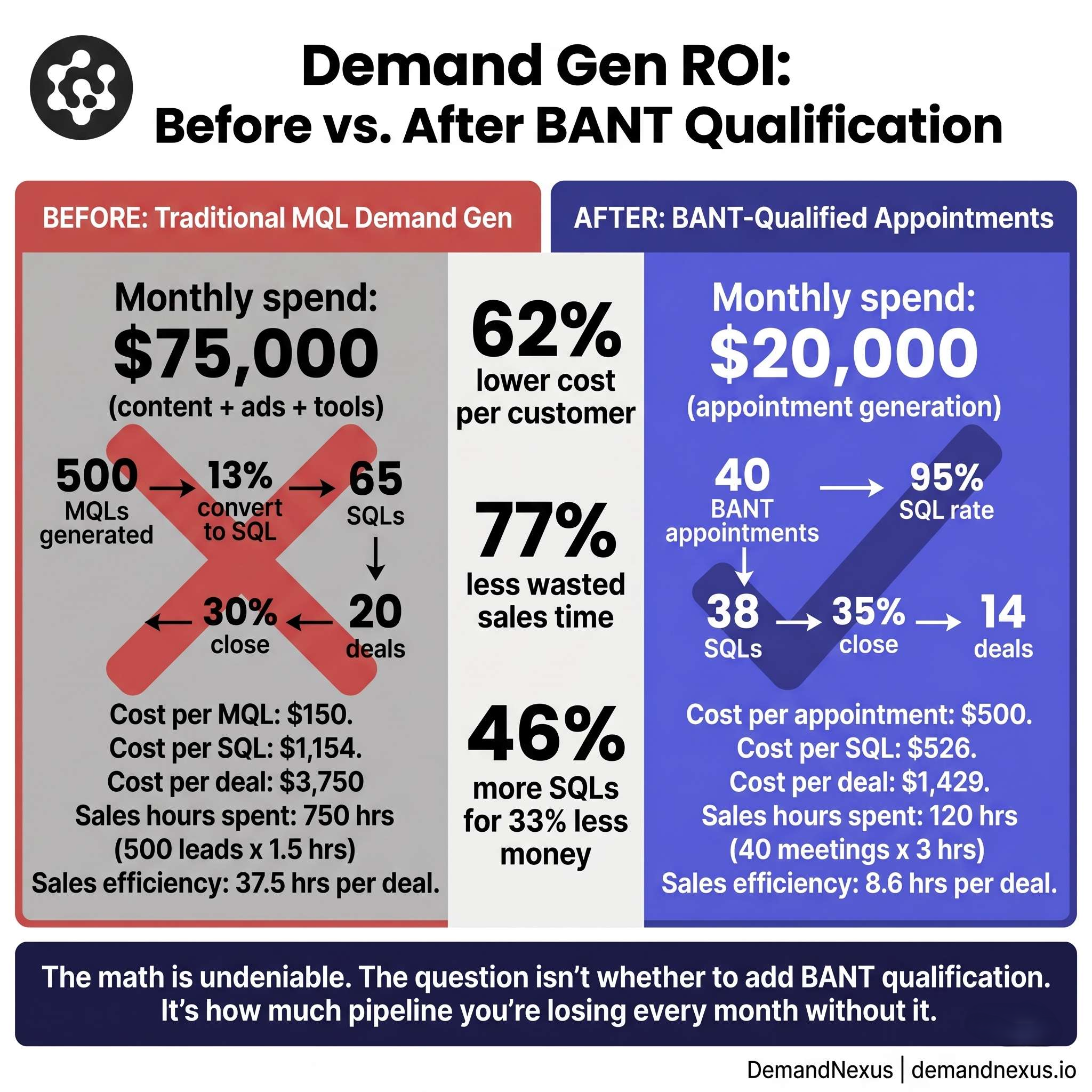
The common foundation: rigorous BANT qualification ensures that regardless of which model sources the opportunity, every appointment meeting your AE’s calendar has verified budget, authority, need, and timeline.
FAQs
What is the difference between demand generation and growth marketing?
Demand generation focuses on creating pipeline with new qualified buyers. Growth marketing optimizes the entire revenue lifecycle—acquisition, activation, retention, expansion, and referral. They are complementary: demand generation fills the funnel, growth marketing optimizes it.
How does demand generation compare to ABM?
Demand generation creates pipeline across your total addressable market. ABM focuses pipeline efforts on specific high-value target accounts. Most successful B2B programs use demand generation for scale and ABM for precision on strategic accounts.
What is demand capture vs. demand generation?
Demand capture targets buyers already searching for solutions (search ads, review sites). Demand generation creates awareness among the 95-97% of your market not yet actively searching. Both are necessary; most companies under-invest in generation.
Can you combine demand generation with ABM?
Yes—and the best programs do. Use demand generation to build broad pipeline and first-party intent data. Layer ABM tactics on top for your highest-value target accounts. This gives you both scale and precision.