



What Is BANT Qualification?
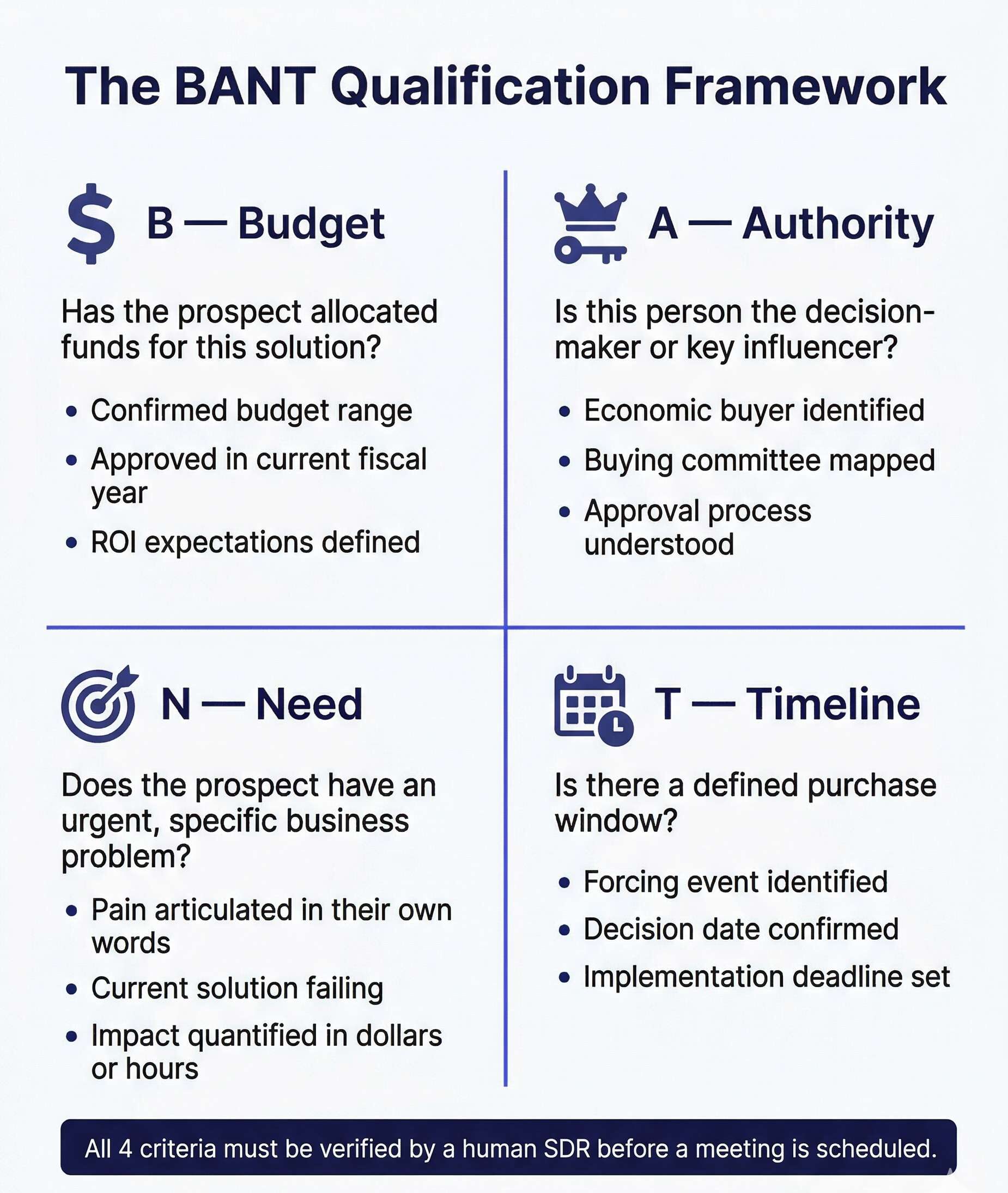
BANT is the original sales qualification framework, developed at IBM in the 1960s and still the backbone of most modern pipeline processes. The acronym stands for:

Most B2B teams lose 40–60% of qualified prospects to broken handoffs and weak qualification. Take our 2-minute diagnostic to find out where your pipeline is bleeding — and how to fix it.
Start the Quiz → Takes 2 minutes. No email required to start.- Budget: does the prospect have allocated or allocatable funds for a solution in your category?
- Authority: is the person you are talking to a decision-maker or part of a verified buying committee?
- Need: is there a documented business problem your solution solves?
- Timeline: is there a committed purchase window, not a vague someday?
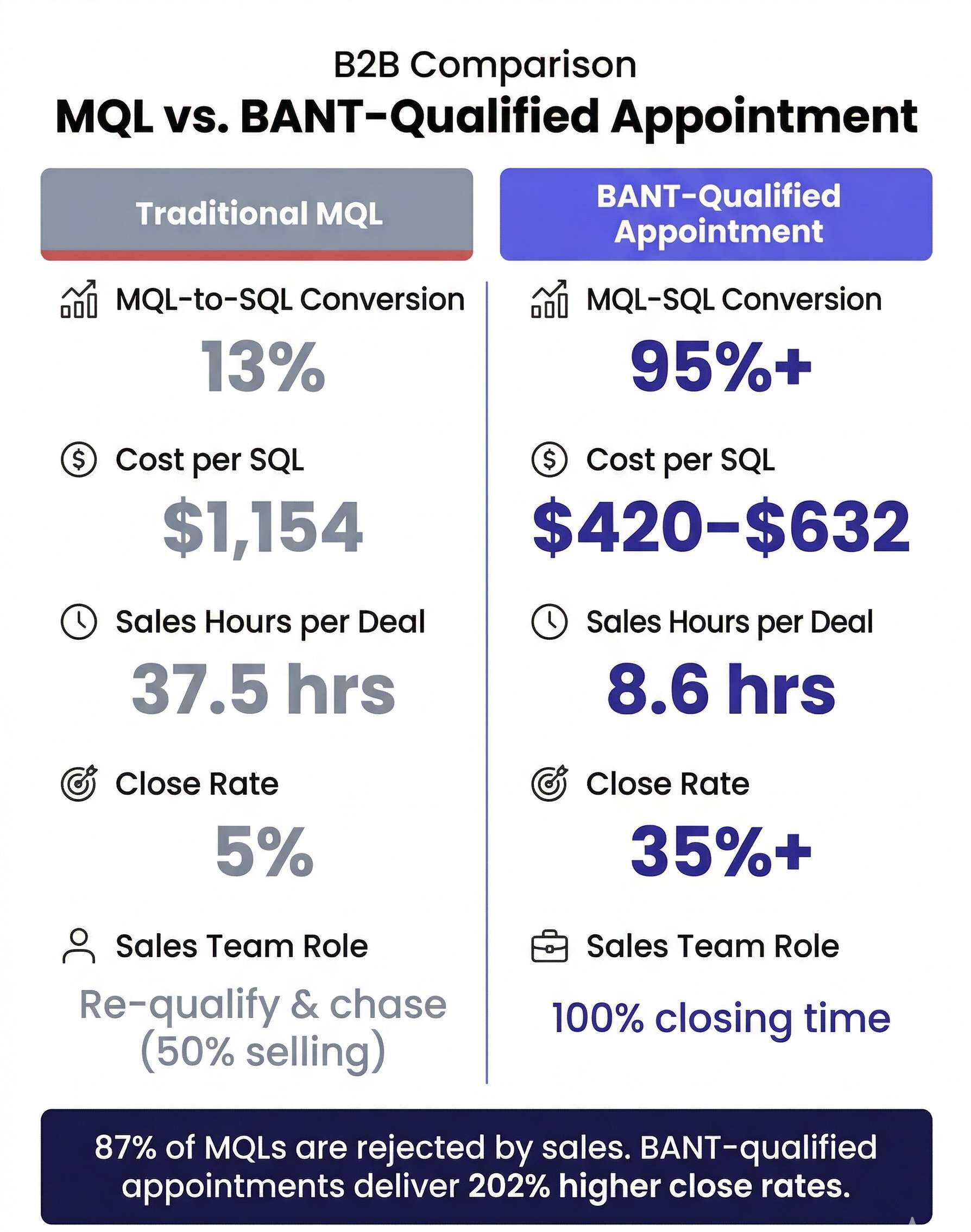
When a prospect passes all four checks, they are BANT-verified. When any single check fails, the lead is rejected before consuming AE time. This is the discipline that separates revenue-generating pipeline from the 87 percent of MQLs sales teams routinely throw out.
What Is ICP Scoring?
ICP scoring, or Ideal Customer Profile scoring, is the firmographic and behavioral model you use to rank accounts before qualification. It tells you which companies deserve outreach in the first place. Without an ICP score, SDR teams waste cycles on accounts that could never close regardless of BANT status.

A modern ICP score combines three layers:
- Firmographic fit: industry, employee count, revenue range, geography
- Technographic fit: current tech stack, tools that signal compatibility
- Behavioral signals: intent data, content engagement, research activity
BANT vs. MEDDIC vs. CHAMP vs. Other Qualification Frameworks
BANT is not the only qualification framework. Here is how the major options compare:

| Framework | Stands For | Best For | Key Weakness |
| BANT | Budget, Authority, Need, Timeline | Transactional to mid-complexity deals | Misses multi-stakeholder dynamics |
| MEDDIC | Metrics, Economic buyer, Decision criteria, Decision process, Identify pain, Champion | Enterprise, complex deals | Time-intensive, overkill for SMB |
| MEDDPICC | MEDDIC plus Paper process and Competition | Enterprise with procurement complexity | Even more time-intensive than MEDDIC |
| CHAMP | Challenges, Authority, Money, Prioritization | Challenger-style selling | Less structured than BANT or MEDDIC |
| SPIN | Situation, Problem, Implication, Need-payoff | Consultative, diagnostic sales | Qualification methodology not framework |
| ANUM | Authority, Need, Urgency, Money | Reorders BANT to lead with authority | Same coverage as BANT |
| GPCTBA/C&I | Goals, Plans, Challenges, Timeline, Budget, Authority, Consequences, Implications | HubSpot-style inbound | Complex acronym, hard to operationalize |
The right framework depends on deal complexity. For most B2B technology companies with five-figure to low-six-figure deal sizes, BANT remains the most practical because it is fast to apply and produces clear pass/fail outcomes. MEDDIC and MEDDPICC make more sense for enterprise deals above $250K ACV with six-plus-month cycles.
Building an ICP Scoring Rubric for B2B Executive Outreach
Executive outreach requires tighter ICP scoring than mass prospecting because the cost of a wrong meeting is higher. An executive who takes a poorly qualified meeting and has a bad experience will not take your next one. Here is a practical scoring rubric we use at DemandNexus for executive-level outreach.
Layer 1: Firmographic Fit (0 to 40 points)
- Industry match to ICP (10 points)
- Employee count in target range (10 points)
- Revenue in target range (10 points)
- Geography matches deployment capability (10 points)
Layer 2: Technographic Fit (0 to 30 points)
- Uses complementary tools in stack (10 points)
- Does not use a direct competitor (10 points)
- Has technical prerequisites for your solution (10 points)
Layer 3: Behavioral and Intent Signals (0 to 30 points)
- Shows first-party intent on category content (15 points)
- Recent hiring or funding signals (10 points)
- Engagement with your brand in the last 90 days (5 points)
An account scoring 80 or higher enters the outreach queue. Below 60, the account is parked until signals change. Between 60 and 80, the account enters a nurture track rather than direct outreach.
ICP Scoring Criteria for Specific Verticals
Generic ICP models break down in niche verticals. Here are two examples of vertical-specific scoring we use.
Boutique Investment Bank ICP Scoring Criteria
For technology vendors selling into boutique investment banks, standard firmographics miss the point. The relevant criteria look like this:
- Sub-$500M AUM range (smaller banks are more decision-nimble)
- Headcount between 15 and 100 employees
- Active deal activity in the last 12 months (signals growth mode)
- Partner or Managing Director named as potential economic buyer
- Current stack includes deal room or CRM software (signals tech adoption)
- Recent hires in operations or technology roles
B2B Executive Outreach ICP Scoring
When the motion is executive outreach rather than SDR-to-manager outreach, scoring weights shift. Authority and priority signals matter more than pure firmographics:
- Executive is a net-new hire in the last 12 months (new executives reshape stacks)
- Executive has publicly discussed your category (LinkedIn posts, podcast appearances)
- Company is in a strategic pivot or transformation phase
- Buying committee includes at least two aligned stakeholders
The BANT Verification Process Step by Step
Step 1: Pre-Call Research
Before any conversation, gather observable signals. Public filings, job postings, LinkedIn activity, and intent data all pre-answer parts of BANT without needing to ask.
Step 2: Opening Conversation
Lead with Need. Confirm the business problem before probing budget or timeline. Prospects tune out transactional qualification questions, but they engage with diagnostic conversations about their actual pain.
Step 3: Authority Mapping
Ask explicitly: who else will be involved in this decision? If you are not talking to the economic buyer, map the path to them. Single-threaded deals at the manager level have a 50 percent lower close rate than multi-threaded deals with executive involvement.
Step 4: Budget Qualification
Budget does not have to be specific dollar amount. It has to be a verified funding path. Three questions to ask: is there allocated budget, is there an approval process you understand, and is the spend range aligned with your pricing.
Step 5: Timeline Verification
Urgency kills vaporware pipelines. Verify: what event is forcing action, what happens if the decision is delayed six months, who else is competing for this budget window.
Step 6: Documentation in the Handover Sheet
Everything verified during qualification belongs in an Appointment Handover Sheet (AHO). The AE should walk into the meeting knowing every BANT answer, every stakeholder, and every decision criterion before the first minute of the call.
How DemandNexus Runs BANT at Scale
Volume and BANT rigor usually trade off. Manual BANT means slow pipeline. Automated BANT means sloppy pipeline. The DemandNexus Cyborg SDR Pod solves this by splitting the work: AI handles enrichment, intent monitoring, and signal analysis, while trained human SDRs run the actual BANT conversation. Every appointment arrives with a complete AHO documenting each BANT pillar, which is why our clients see 90 percent plus show rates and 60 percent plus SQL conversion.
FAQs
What is BANT qualification?
BANT qualification verifies Budget, Authority, Need, and Timeline before a sales meeting is confirmed. When all four pillars are verified, the prospect is appointment-ready. When any pillar fails, the lead is rejected before consuming AE time.
What is the difference between BANT and MEDDIC?
BANT is a four-pillar qualification model best suited to mid-complexity B2B deals. MEDDIC adds metrics, decision criteria, decision process, pain, and champion mapping, making it more thorough but more time-intensive. MEDDIC is the better choice for enterprise deals above $250K ACV.
How do you build an ICP scoring rubric?
A strong ICP scoring rubric uses three layers: firmographic fit (industry, size, revenue, geography), technographic fit (stack compatibility), and behavioral signals (intent data, engagement). Weight each layer based on what predicts close rate in your historical data, not on intuition.
Is BANT still relevant in 2026?
Yes, and arguably more relevant than ever. As paid acquisition costs have climbed (Google Ads CPLs up 70 percent since 2021, LinkedIn averaging $408 per lead), the cost of unqualified pipeline has never been higher. BANT is the fastest way to reject bad-fit leads before they absorb AE time and marketing spend.
What qualifies as a BANT-verified lead?
A BANT-verified lead has documented budget (or a verified funding path), confirmed buying authority (or a mapped path to the economic buyer), an articulated business need that your solution addresses, and a committed decision timeline. All four must be explicitly verified, not inferred.