


Introduction
SaaS sales funnel optimization is the process of identifying and fixing conversion leaks at each stage of the buying journey from first awareness through closed deal and customer retention. Most SaaS companies focus optimization efforts on the bottom of the funnel (demo-to-close, proposal-to-contract) while ignoring the most impactful lever: the quality of leads entering the top.
The most common funnel problem in B2B SaaS isn’t a closing problem. It’s a qualification problem. When 87% of MQLs never convert, the bottleneck is upstream not in your AEs’ closing skills, but in the leads your marketing team is passing to sales.

Most B2B teams lose 40–60% of qualified prospects to broken handoffs and weak qualification. Take our 2-minute diagnostic to find out where your pipeline is bleeding — and how to fix it.
Start the Quiz → Takes 2 minutes. No email required to start.The SaaS Sales Funnel: Stage by Stage
Stage 1: Awareness and Top-of-Funnel
Top-of-funnel represents prospects who are aware of a problem but haven’t yet entered a buying process. Marketing metrics at this stage: organic traffic, paid impressions, content engagement. The conversion goal: move problem-aware prospects to solution-aware research.
Stage 2: Consideration and MQL
Consideration stage represents prospects actively researching solutions. Traditional demand generation programs convert consideration-stage prospects to MQLs contact records with engagement scores. This is where the funnel first leaks: 87% of MQLs never become revenue. The gap is qualification.
Stage 3: Qualification (SQL/BANT)
The qualification stage is the most important and most neglected stage in most SaaS funnels. Converting an MQL to an SQL requires confirming Budget, Authority, Need, and Timeline through direct conversation. Organizations that do this confirmation before the AE meeting rather than during discovery see 90%+ SQL conversion rates versus the 13% industry average for unqualified MQLs.

Stage 4: Demo and Evaluation
The demo stage is where your AE presents the product and confirms fit with the prospect’s specific needs. Demo conversion rates improve significantly when the AE enters the call with BANT documentation from the qualification stage, tailoring the demo to the specific pain points and evaluation criteria the prospect has confirmed.
Stage 5: Proposal and Negotiation
Proposal stage conversion depends on three factors: how well the proposal addresses the specific pain points uncovered in discovery, how aligned the pricing is with the budget confirmed in BANT qualification, and how many decision-makers are engaged and supportive of the purchase.

Stage 6: Close and Contract
The close rate for BANT-qualified opportunities runs 202% higher than for non-qualified leads. When Budget, Authority, Need, and Timeline are confirmed before the AE’s first conversation, the close is a natural progression of a qualification process the prospect has already participated in not a cold persuasion effort.
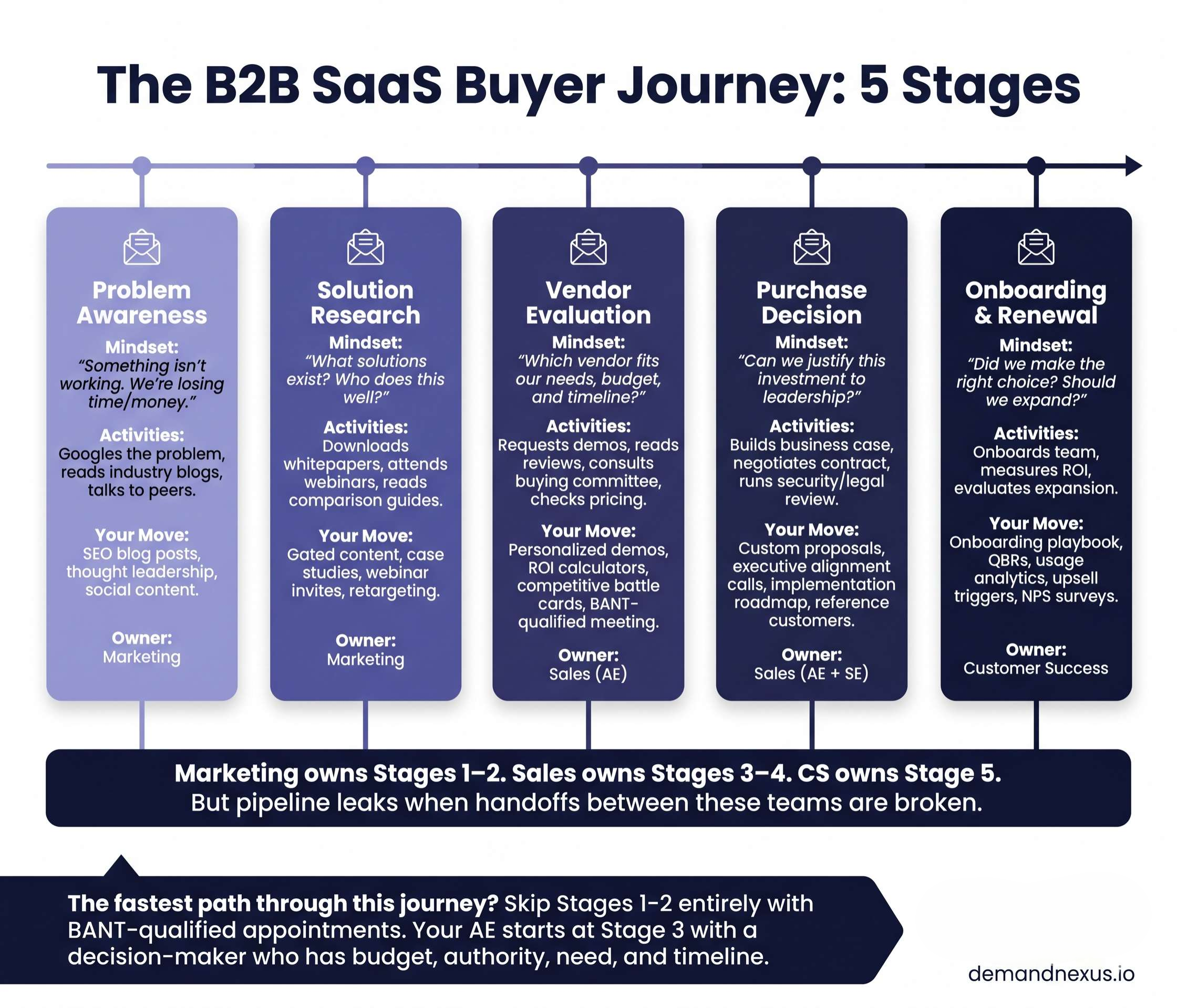
Common SaaS Funnel Conversion Leaks and How to Fix Them
Leak: High MQL Volume, Low SQL Conversion
Cause: Marketing is optimizing for engagement activity (downloads, webinar registrations) rather than buyer readiness. Fix: Replace MQL thresholds with BANT qualification. Every prospect should be verified on Budget, Authority, Need, and Timeline through direct conversation before entering the AE pipeline.
Leak: High Demo Booking, Low Demo-to-Proposal
Cause: Demos are being booked with prospects who haven’t confirmed their need or timeline. Fix: Require confirmed Need and Timeline as qualification criteria before a demo is scheduled. Demos with unqualified prospects produce low-quality ‘educational conversations,’ not pipeline.
Leak: Strong Pipeline Coverage, Low Win Rate
Cause: Pipeline is inflated with unqualified opportunities prospects who pass early qualification filters but haven’t confirmed budget authority or competitive context. Fix: Add Authority and Budget checkpoints at the proposal stage. A prospect who can’t make the decision or doesn’t have the budget can’t close, regardless of how strong the demo was.
Leak: High No-Show Rate
Cause: Appointments are being booked without confirmed timeline and urgency. A prospect with no urgency has no reason to show up. Fix: Require an urgency driver as part of Timeline qualification a contract renewal date, a board initiative, a product launch deadline before any appointment is confirmed.
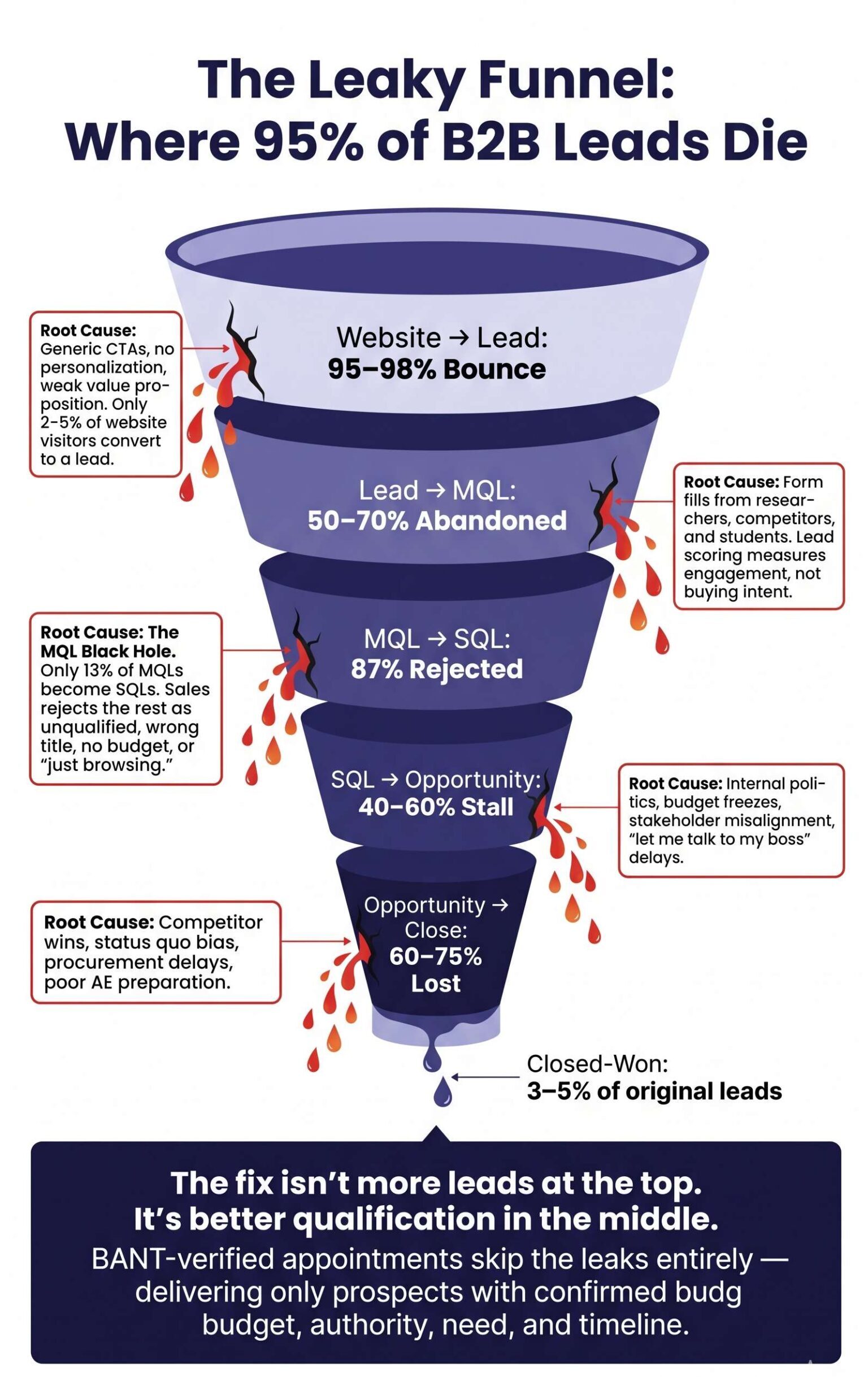
SaaS Funnel Metrics: What to Track at Each Stage
- Top-of-funnel: Organic traffic growth, paid traffic CPL, content engagement (time on page, scroll depth)
- Consideration stage: MQL volume, cost per MQL by source
- Qualification stage: MQL-to-SQL conversion rate (benchmark: 13% industry; 90%+ with BANT pre-qualification)
- Demo stage: Demo-to-proposal conversion rate (benchmark: 40–60% for well-qualified demos)
- Proposal stage: Proposal-to-close rate (benchmark: 20–35% for mid-market SaaS)
- Pipeline: Coverage ratio (target 3–4x), weighted pipeline value, slippage rate
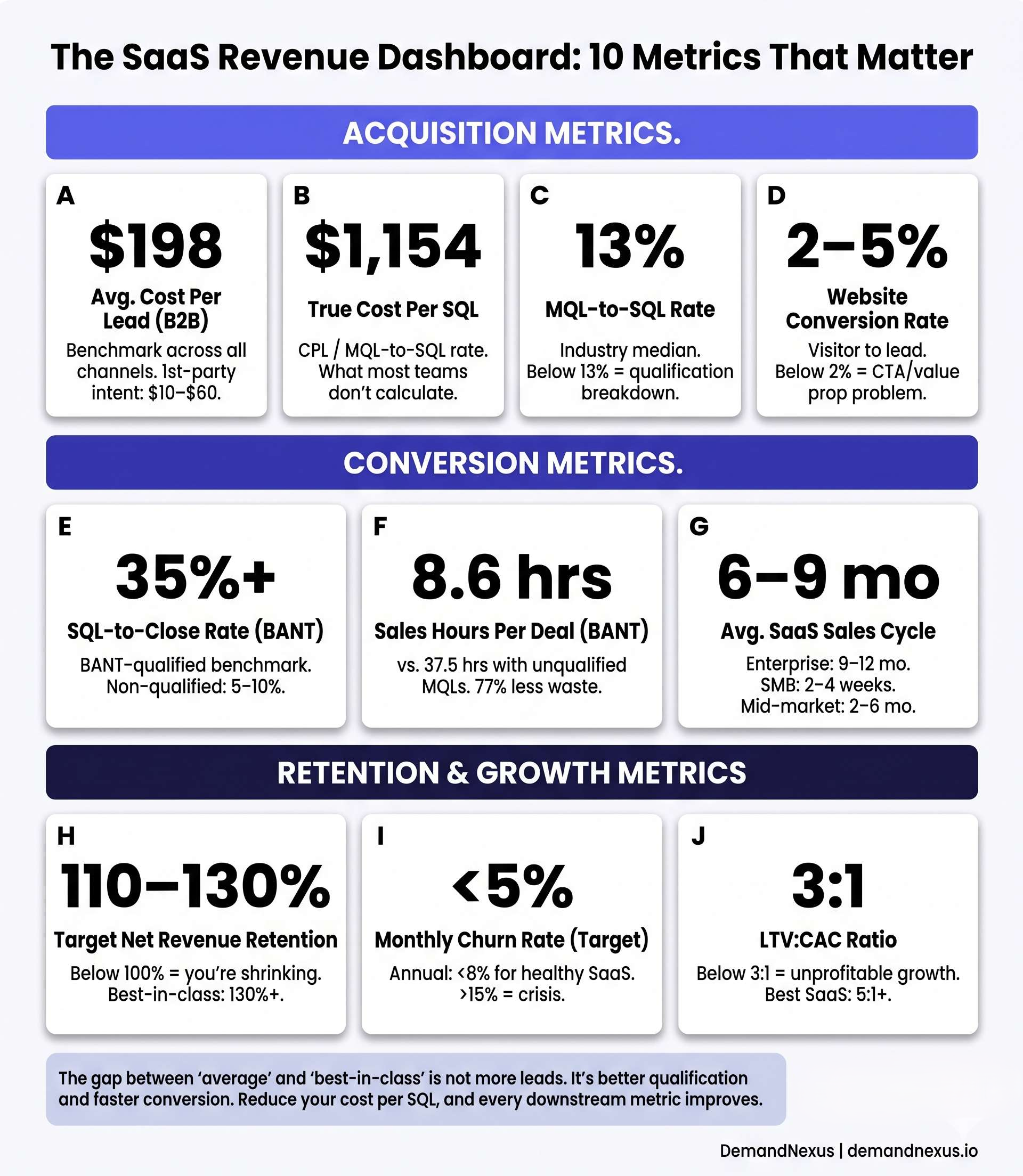
How BANT-Qualified Appointments Optimize the Entire Funnel
The most powerful SaaS funnel optimization isn’t a bottom-of-funnel tactic it’s a top-of-funnel intervention. When every appointment on your AE’s calendar arrives with confirmed BANT qualification and a full Appointment Handover Sheet, every downstream stage improves:
- Demo conversion: Demos tailored to pre-documented pain points convert 2–3x higher
- Proposal win rate: Proposals calibrated to confirmed budget ranges see less pricing pushback
- Close rate: BANT-qualified prospects close at 202% higher rates than non-qualified leads
- Sales cycle length: BANT qualification reduces cycle length by 20–40% by eliminating re-qualification stages
- AE efficiency: Under 5 hours/week on qualification (versus 30+ hours with unqualified pipelines)
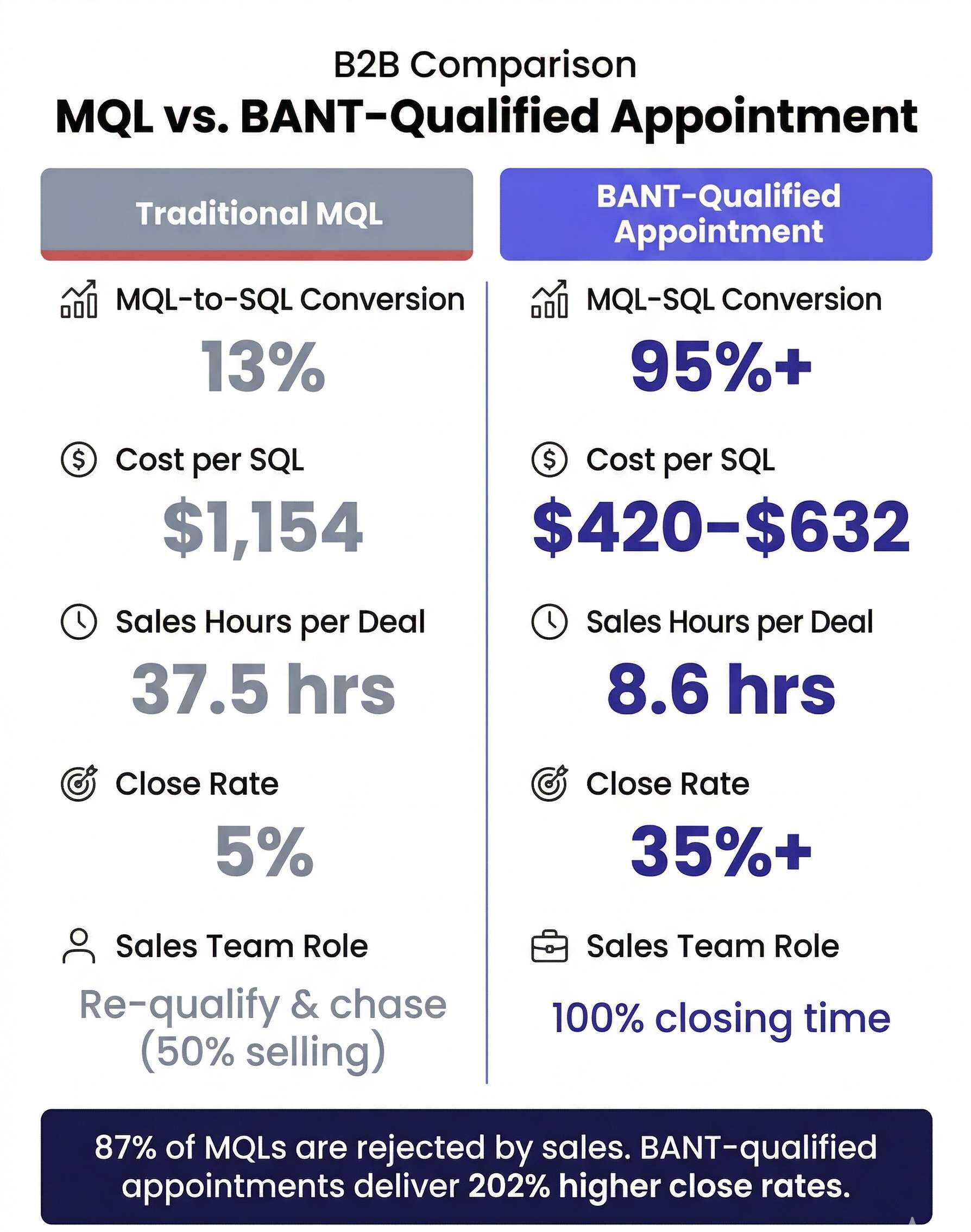
DemandNexus’s Waterfall Model delivers this qualification layer as a pay-for-performance service: $500 per BANT-verified appointment, with no-show replacement at no cost within five business days.
FAQs
What is a SaaS sales funnel?
A SaaS sales funnel is the staged process through which a prospect moves from first awareness of your product to becoming a paying customer. Stages typically include: awareness, consideration, qualification, demo/evaluation, proposal, and close.
What is the biggest cause of SaaS funnel leakage?
The most common cause of SaaS funnel leakage is unqualified leads entering the AE pipeline. When MQLs are based on engagement activity rather than BANT criteria, 87% of them never convert — creating a bottleneck that no bottom-of-funnel optimization can fix.
How do I improve my SaaS sales funnel conversion rate?
The highest-impact improvement is adding BANT qualification before meetings are booked. Ensuring every appointment has confirmed Budget, Authority, Need, and Timeline improves every downstream conversion rate — demo-to-proposal, proposal-to-close, and overall win rate.
What is a good MQL-to-SQL conversion rate for SaaS?
The industry average MQL-to-SQL conversion rate is 13%. Organizations using BANT-qualified appointment programs achieve 90%+ conversion because qualification happens before the meeting is booked.
What is funnel coverage ratio?
Pipeline coverage ratio measures the total value of pipeline opportunities divided by your revenue target. A 3–4x coverage ratio is a typical benchmark — meaning if your quarterly revenue target is $1M, you want $3–4M of pipeline to generate enough opportunities to hit target with expected attrition.