



Most B2B organizations excel at one or two of these practices while neglecting the rest. They personalize their outreach but skip qualification. They qualify rigorously but deliver no context to AEs. They measure activity but not outcomes. The companies that dominate their markets execute all 15 consistently.

Most B2B teams lose 40–60% of qualified prospects to broken handoffs and weak qualification. Take our 2-minute diagnostic to find out where your pipeline is bleeding — and how to fix it.
Start the Quiz → Takes 2 minutes. No email required to start.This guide compiles the appointment setting best practices that produce measurable pipeline, drawn from current benchmark data and tested across B2B verticals ranging from SaaS to managed services to financial technology.
Targeting and Preparation
1. Define Your ICP With Five or More Attributes
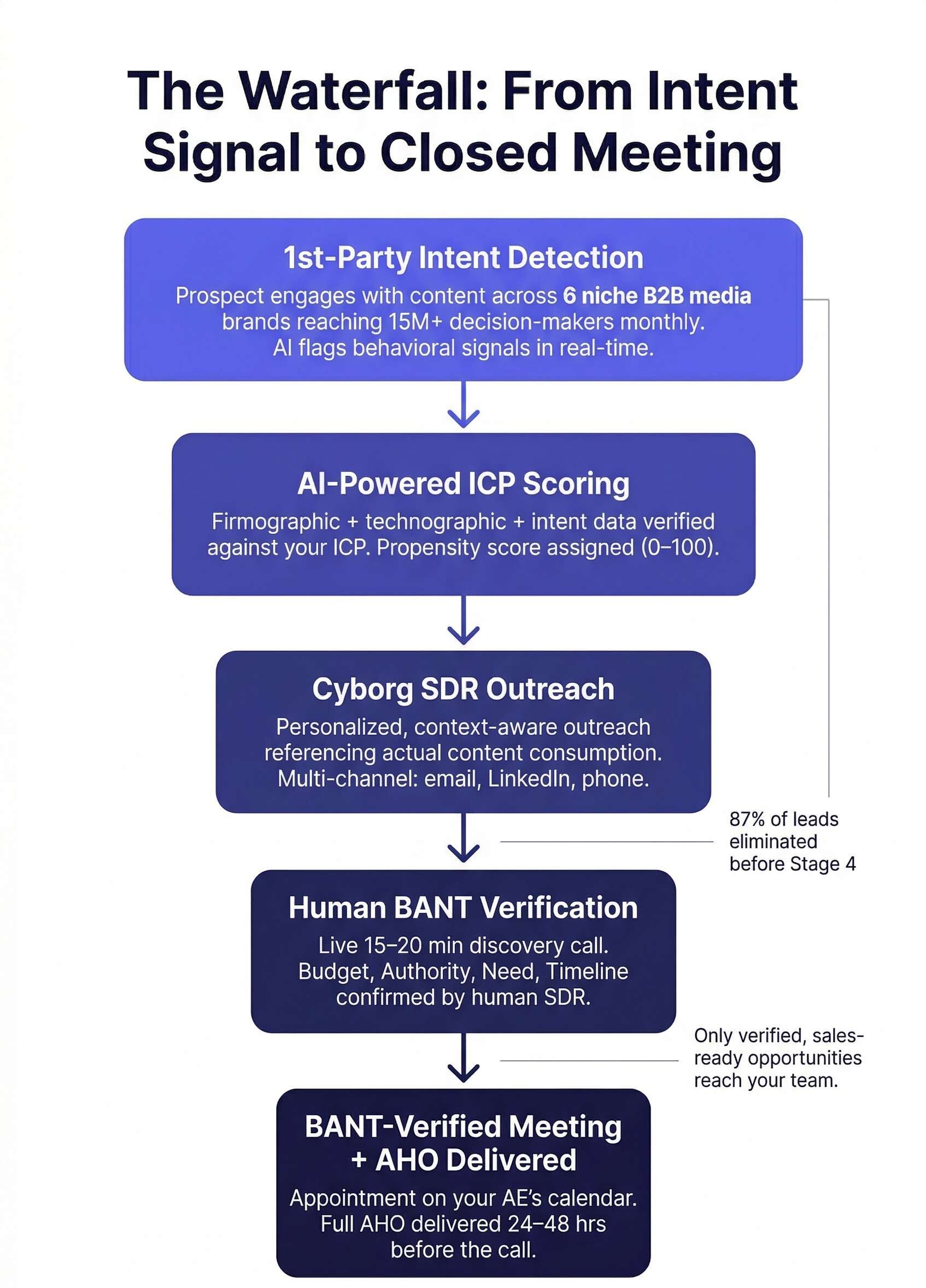
Companies that define five or more ICP attributes (firmographic, technographic, demographic, situational, and behavioral) report 2x higher meeting-to-opportunity conversion than those using broad targeting. Go beyond company size and industry. Include technology stack, recent funding, hiring patterns, and content engagement signals. For a detailed ICP development framework, see our guide to B2B prospecting.
2. Layer Intent Data on Your Target List
Static ICP matching tells you who could buy. Intent data tells you who is likely buying now. Layer behavioral signals content engagement, technology evaluation, job postings, funding events on top of your ICP-matched list to prioritize prospects showing active buying signals. This shifts your outreach from interruption to relevance. First-party intent data from owned audiences is dramatically more valuable than third-party signals purchased from aggregators. See our guide on ABM intent data for implementation details.
3. Research Every Prospect Before Outreach
Spend 5-10 minutes per prospect before making first contact. Review their LinkedIn profile, recent company news, technology stack (check their careers page and BuiltWith), and any content they have published or engaged with. This investment converts to personalization that earns responses. SDRs who personalize based on research book 3x more meetings than those who rely on templates. For prospecting research tactics, see our guide to sales prospecting techniques.
Outreach Execution
4. Execute Multi-Channel Cadences
Prospects contacted through three or more channels (email, phone, LinkedIn) convert at 3x the rate of single-channel outreach. Build structured cadences of 8-12 touchpoints over 14-21 days that coordinate messaging across channels. For cadence design principles, see our guide to building B2B sales cadences.

5. Lead With Value, Not Pitch
Every touchpoint should offer something useful before asking for anything. Share benchmark data, a relevant case study, an industry insight, or a perspective on a challenge the prospect faces. Outreach that provides value earns attention. Outreach that leads with a product pitch gets filtered. Our guide on B2B content marketing strategy covers how to create the assets that power value-first outreach.
6. Personalize at the Trigger and Pain-Point Level
“Hi [First Name], I noticed [Company Name]” is not personalization it is mail merge. Real personalization references a specific trigger (their recent funding round, a job posting they published, an article they shared) connected to a specific challenge relevant to their role. This level of personalization requires the research from Practice 3 and produces dramatically higher engagement rates.
7. Follow Up Persistently but Respectfully
Most meetings are booked on the third to fifth touchpoint. SDRs who give up after two attempts leave significant pipeline on the table. But persistence must be respectful each follow-up should add new value (a different insight, a new case study, a different angle) rather than simply asking “did you see my last email?” For proven follow-up strategies, our guide on cold email response rates provides benchmarks that show the optimal number of touchpoints.
Qualification Standards
8. Implement Non-Negotiable BANT Verification
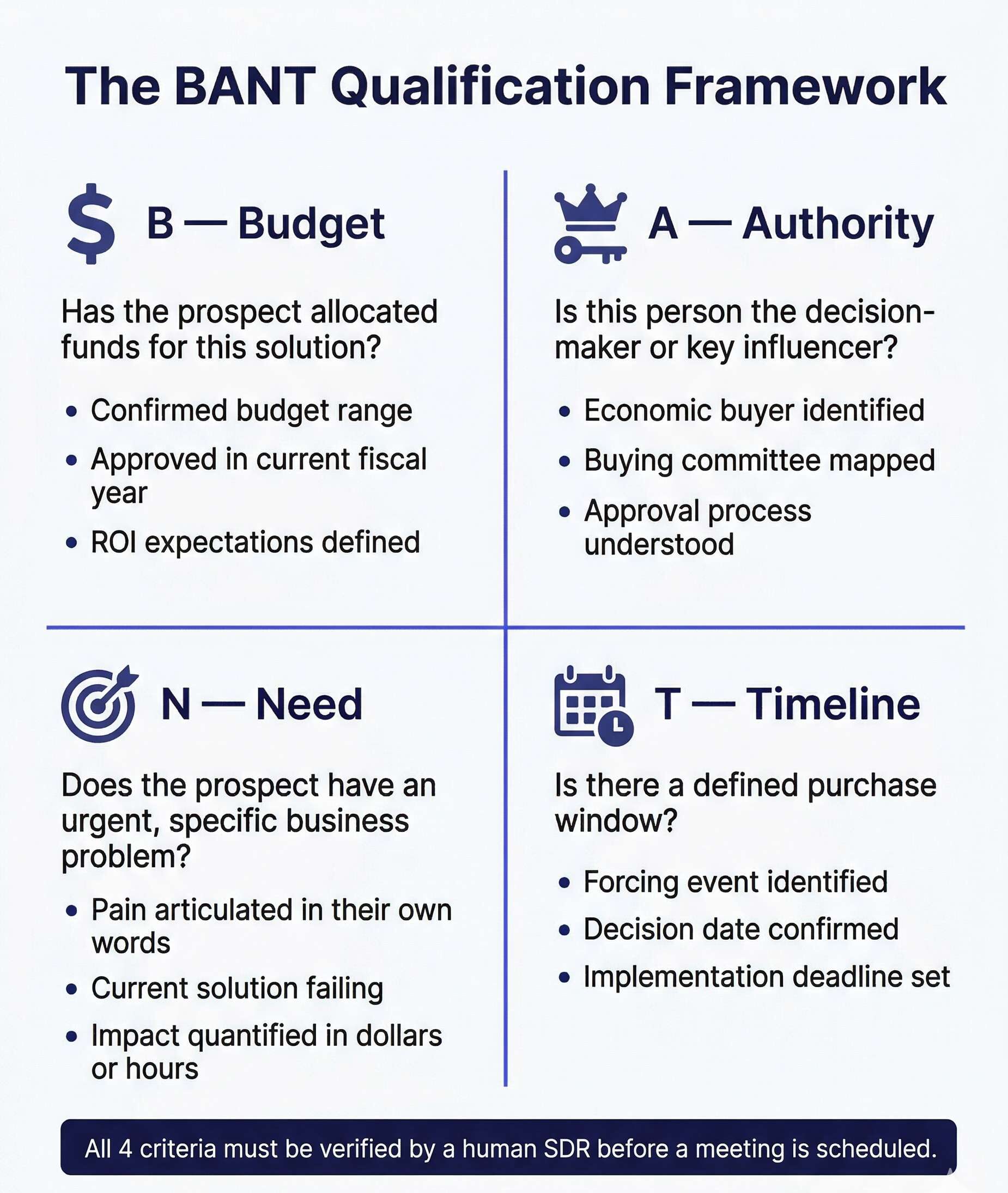
The single highest-impact practice on this list. Require verified Budget, Authority, Need, and Timeline for every appointment before it reaches your AE’s calendar. SDRs who skip qualification to boost meeting numbers create downstream waste that costs multiples of what the meetings saved in booking time. See our complete guide to qualified appointment setting for the full methodology.
9. Disqualify Aggressively
The willingness to disqualify prospects who do not meet BANT criteria is what separates high-performing appointment setting programs from activity-generating ones. Disqualified prospects are not lost they enter nurture sequences where they can be re-engaged when their situation changes. But they do not sit on your AE’s calendar consuming selling time. For nurturing strategies that keep disqualified prospects warm, see our article on lead nurturing and why it matters in B2B.
10. Use Scoring to Prioritize, Not Just Qualify
Beyond the binary qualified/disqualified decision, score leads on a scale that reflects their readiness and fit. A prospect with confirmed BANT and recent high-intent behavior (multiple content downloads, website visits to pricing page) should be prioritized over a prospect with confirmed BANT but lower engagement signals. This scoring ensures your AEs receive the highest-potential meetings first.
Meeting Handoff and Follow-Through
11. Deliver Comprehensive Pre-Meeting Intelligence
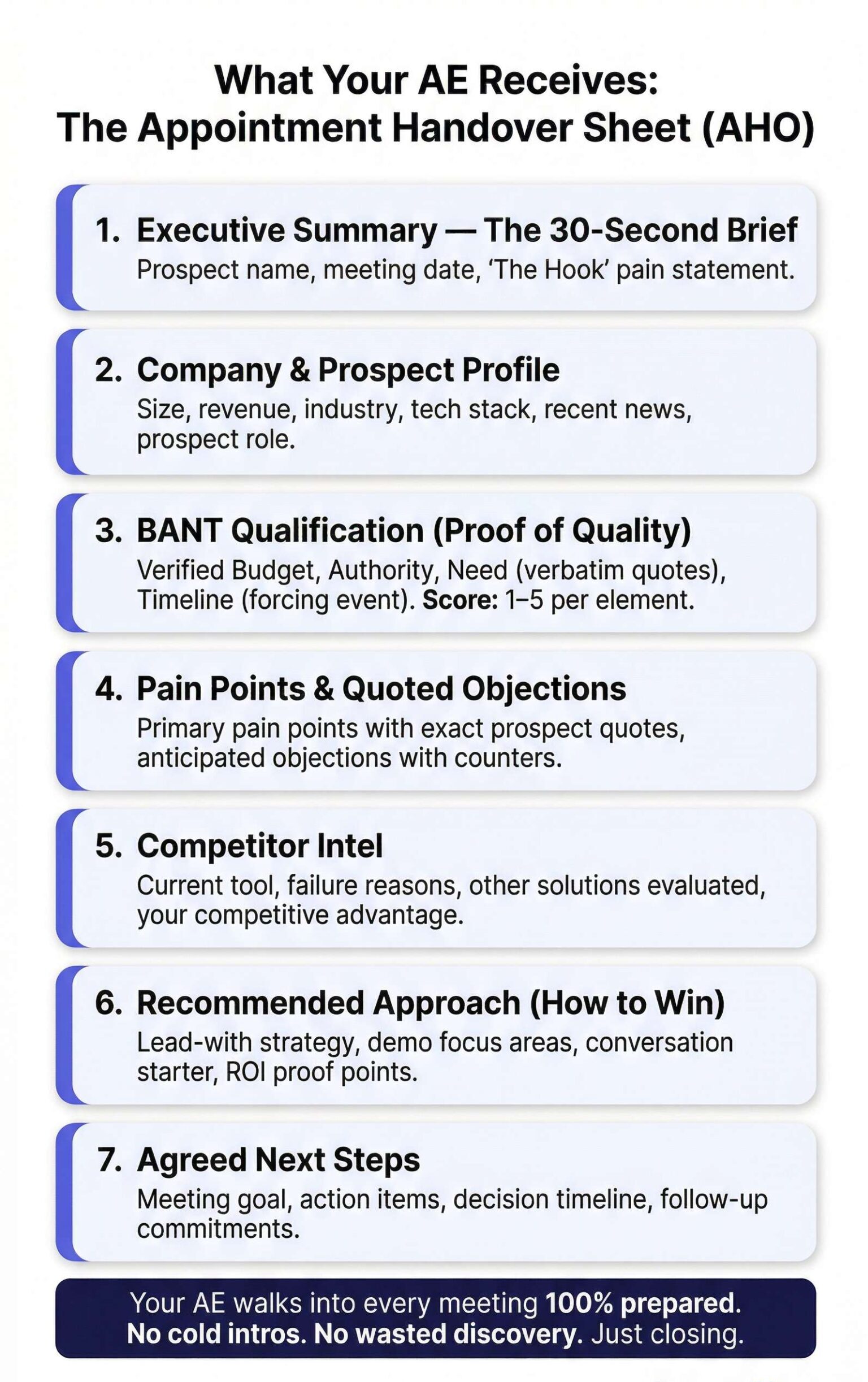
Every appointment should include detailed documentation for your AE: a one-paragraph executive summary, verified BANT details with verbatim evidence, conversation history, competitive context, and recommended opening strategy. DemandNexus delivers this through their Appointment Handover Sheet (AHO) a model that AE teams consistently cite as the reason their close rates exceed industry benchmarks. Meetings backed by comprehensive handover convert at 2-3x the rate of meetings where AEs walk in cold. Learn more about the AHO approach in our guide to what appointment setters deliver.
12. Confirm Meetings 24 Hours in Advance
No-show rates for B2B meetings average 20-30%. A simple confirmation email or call 24 hours before the meeting reduces no-shows by 30-50%. Include a brief recap of what the meeting will cover and confirm the attendee list. If the prospect needs to reschedule, it is better to know in advance than to discover an empty Zoom room.
13. Establish a No-Show Follow-Up Protocol
When no-shows occur (and they will), have a documented follow-up process: immediate email within one hour offering alternative times, phone follow-up the next business day, and a reschedule attempt within the cadence. Do not abandon no-shows they have already expressed enough interest to accept a meeting once. The best providers, including DemandNexus, guarantee no-show replacements within five business days at no charge.
Measurement and Optimization
14. Measure Outcomes, Not Activity
Stop tracking calls made, emails sent, and LinkedIn connections requested as primary metrics. Track meeting-to-opportunity conversion rate, cost per qualified meeting, pipeline generated per SDR, and cost per closed deal. These outcome metrics connect appointment setting to revenue and expose quality issues that activity metrics hide. For the complete B2B sales measurement framework, see our guide to B2B sales KPIs.
15. Run Weekly Pipeline Reviews
Review appointment setting performance weekly, not monthly. Analyze which messaging resonates, which verticals convert highest, where prospects drop off, and what objections recur. Use this data to iterate targeting, scripts, and qualification criteria continuously. Companies that optimize weekly outperform those who review monthly by 40%+ in meeting quality metrics. For a broader perspective on pipeline management, see our guide to building a B2B marketing pipeline.
FAQs
What is the single most important appointment setting best practice?
BANT qualification before scheduling. This single practice has the highest impact on meeting-to-opportunity conversion rate, AE productivity, and cost per closed deal. Every other practice amplifies qualification — but qualification is the foundation.
How many touchpoints should an appointment setting cadence include?
8-12 touchpoints across 14-21 days using a multi-channel approach (email, phone, LinkedIn). Most meetings are booked on the 3rd-5th touchpoint. Cadences shorter than 8 touchpoints leave significant pipeline unrealized.
What conversion rate should I expect from qualified appointments?
BANT-qualified appointments should convert at 30-40% to pipeline opportunities. If your conversion rate is below 20%, your qualification standards may be too loose. If above 50%, you may be over-qualifying and leaving volume on the table.
How do I improve appointment setting performance?
Focus on three levers: better targeting (refine ICP and add intent data layers), stricter qualification (implement full BANT verification), and stronger AE enablement (deliver comprehensive pre-meeting intelligence). These three practices compound to produce dramatic improvement.
Should I invest in appointment setting training or outsource?
If you have existing SDRs, invest in training first — most SDR teams underperform due to inadequate qualification methodology, not lack of effort. If you need pipeline faster than training can deliver (or lack SDR headcount entirely), outsource to a qualified provider while building internal capabilities. The two approaches are complementary.