

We have organized them by category: effectiveness, response rates, timing, technology, and the future of cold calling. Every stat includes the range and the “so what” implication. Use these to set realistic expectations, benchmark your program, and build a business case when leadership asks whether cold calling still works.

Most B2B teams lose 40–60% of qualified prospects to broken handoffs and weak qualification. Take our 2-minute diagnostic to find out where your pipeline is bleeding — and how to fix it.
Start the Quiz → Takes 2 minutes. No email required to start.Effectiveness and ROI Statistics
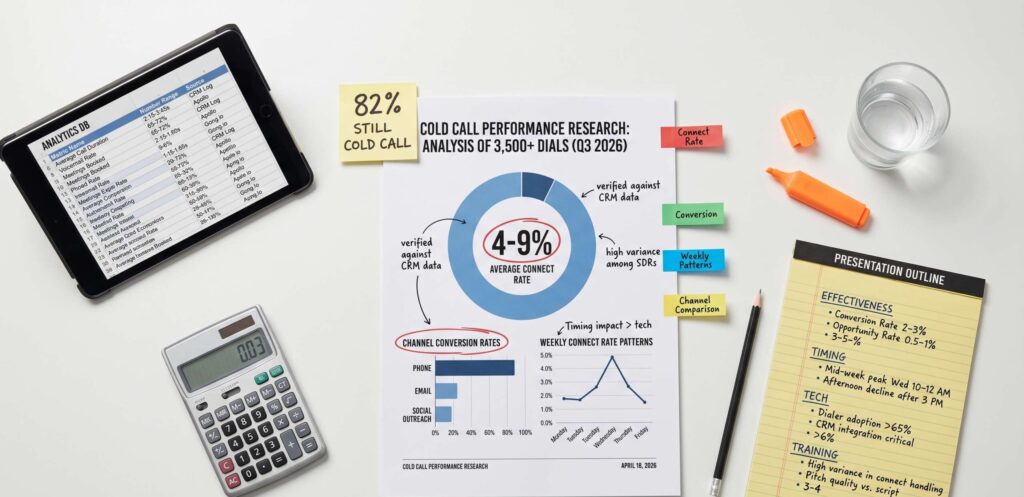
- 82 percent of B2B buyers accept sales meetings from cold outreach at some point during their buying journey, according to Rain Group research.
- Cold calling is still cited as effective by 57 percent of C-level and VP-level buyers, according to DiscoverOrg data.
- Only 2 percent of cold calls result in an appointment on average, but top performers book appointments on 8 to 12% of conversations.
- The average B2B SDR makes 52 calls per day, booking roughly 1 qualified meeting every 40 to 80 dials.
- Fortune 500 companies that maintain active cold calling programs report 15 to 35 percent of pipeline sourced from cold outbound.
- The median cost per booked meeting via cold calling ranges from $150 to $400 for US-based programs.
- Cold calling has a measurable ROI when average contract value exceeds roughly $5,000 in annual revenue.
Connect Rate Statistics
- Average B2B cold call connect rate: 4 to 9 percent of dial attempts reach a live human.
- Direct-dial numbers connect 3 to 5 times more often than main company lines.
- Using local presence phone numbers increases answer rates by 20 to 30 percent.
- Calls from unknown numbers are answered roughly 40 percent less than calls from known local numbers.
- After 6 attempts to the same prospect, incremental connect rate drops below 1 percent.
- Parallel dialers (3 to 6 simultaneous calls) produce roughly 4x more conversations per hour than single-line manual dialing.
Timing Statistics
- Wednesday and Thursday produce the highest B2B cold call connect rates.
- 10 AM to 11:30 AM and 4 PM to 5:30 PM local time are the two best calling windows.
- Monday mornings produce the lowest connect rates of any weekday period.
- Friday after 2 PM sees connect rates drop by 30 to 40 percent from weekly peak.
- The first week of each quarter sees 10 to 20 percent higher connect rates than the last week.
- The 2 weeks between Christmas and New Year see connect rates drop 40 to 60 percent below annual average.
Script and Conversation Statistics
- Successful cold calls average 5 minutes 50 seconds in length according to Gong research, versus 3 minutes 14 seconds for unsuccessful calls.
- Rep talk ratio of 30 to 40 percent produces best meeting conversion. Higher ratios reduce success.
- Calls that include the phrase “reason I am calling” in the first 30 seconds convert 2x better than those that do not.
- Mentioning a competitor by name within the first minute increases engagement but only when followed by a differentiator.
- Calls with one clear next step proposed (not two or three) convert 40 percent better to meetings.
- Calls that open with a question rather than a statement extend conversation length by 25 percent on average.
Objection Handling Statistics
- Top performers average 5.7 objection responses per call versus 1.8 for bottom performers.
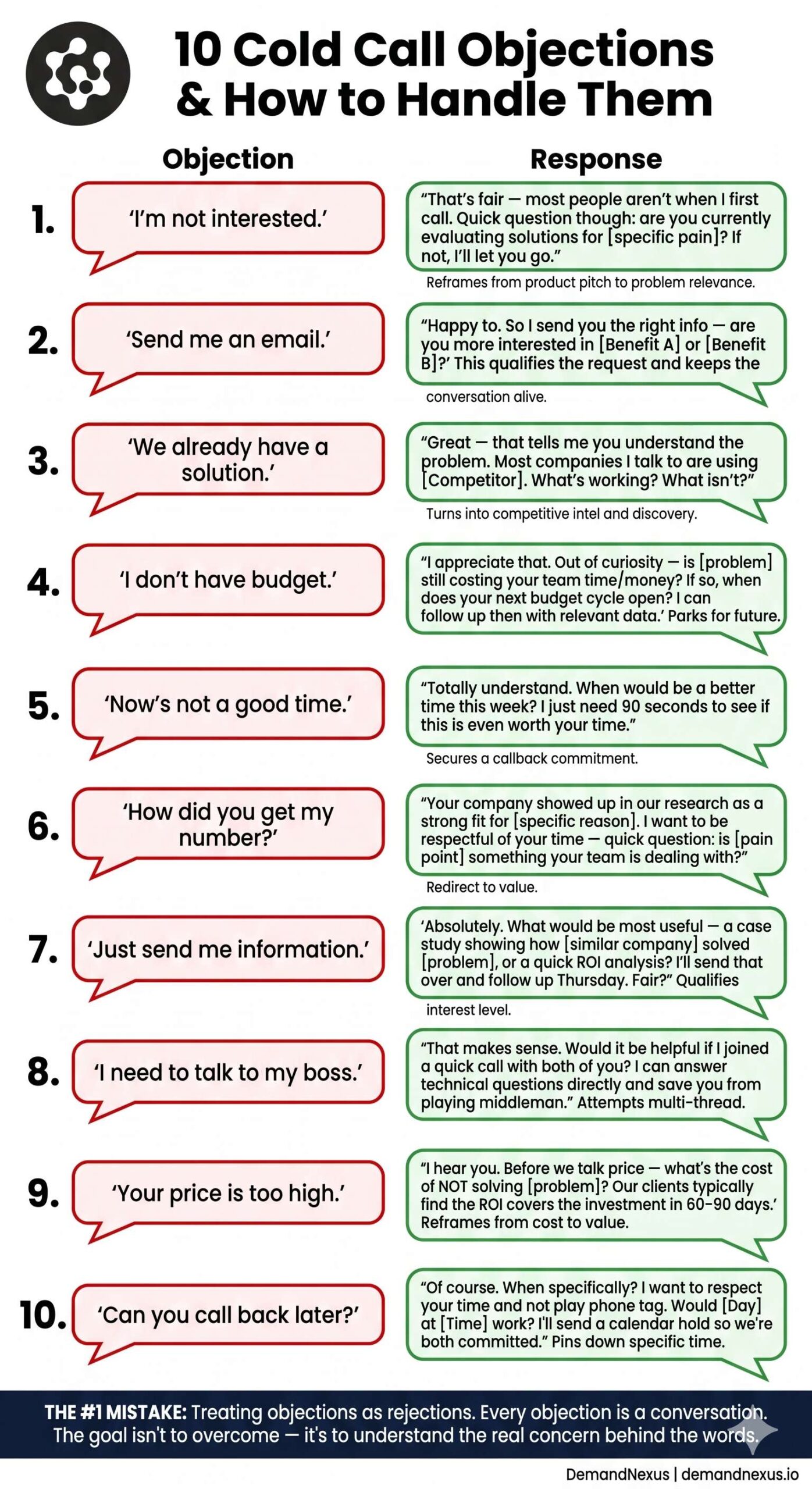
- The most common objections: “not interested” (38 percent), “send me an email” (25 percent), “call back later” (18 percent).
- Calls where the rep validates the objection (with phrases like “makes sense” or “fair”) before responding convert 2x better.
- Asking a follow-up question after an objection rather than immediately rebutting extends call duration by 60 percent.
- Average prospect says some form of “no” 4 times before saying “yes” to a meeting.
Technology and AI Statistics
- Teams using AI-assisted parallel dialers book roughly 2x more meetings per rep-hour than teams using manual dialing.
- 84 percent of modern B2B SDR teams now use some form of call recording and analysis software.
- AI call scoring reduces sales manager coaching time by 40 to 60 percent while increasing rep improvement rates.
- Autonomous AI voice agents currently achieve 50 to 80 percent lower conversion than human reps in complex B2B sales.
- 68 percent of sales leaders expect AI to handle 30+ percent of outbound calling by 2028.
- CRM integration with dialer saves reps an average of 47 minutes per day on logging and data entry.
Follow-Up and Cadence Statistics
- 80 percent of sales require 5+ follow-up calls, but 44 percent of sales reps give up after one call, per Marketing Donut research.
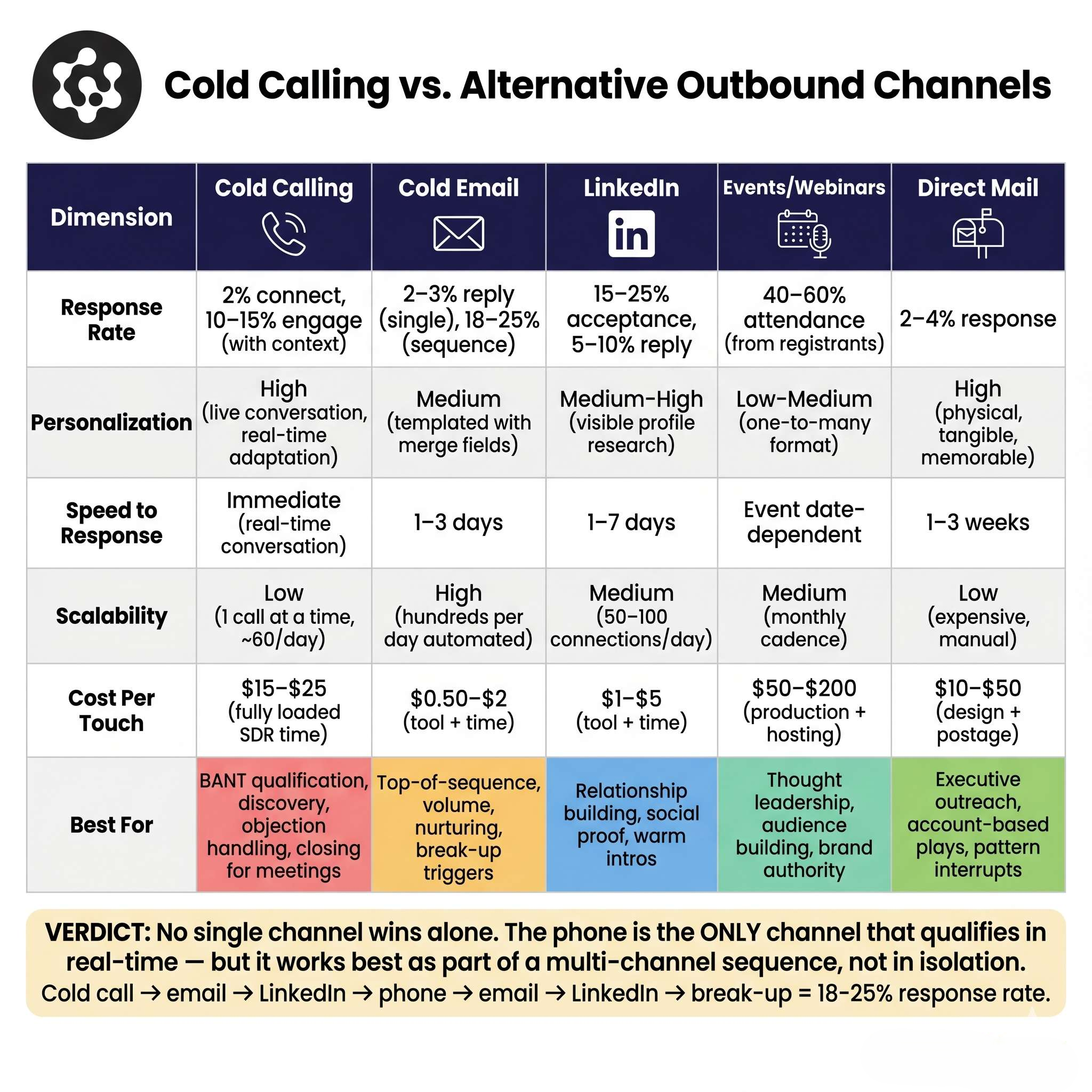
- Multi-channel cadences (call + email + LinkedIn) book 2 to 3x more meetings than single-channel outreach.
- Optimal touch count per prospect: 7 to 12 touches across 2 weeks.
- Voicemails left consistently produce 3 to 4 percent callback rate. Without voicemail, 0 percent.
- Email within 1 hour of a cold call nearly doubles response rate versus 24 hours later.
Training and Team Statistics
- New B2B SDRs take 3.2 months on average to reach full productivity.
- Companies with structured SDR training programs ramp reps 40 percent faster than those without.
- Annual SDR turnover in the US averages 34 percent across industries.
- Teams with weekly 1:1 coaching show 50 percent higher attainment than those with monthly or less.
- Fully loaded cost of a US-based in-house SDR (salary, benefits, tools): $90,000 to $110,000 per year.
The Future of Cold Calling
- 65 percent of sales leaders plan to increase investment in cold calling over the next 2 years, despite widespread predictions of its decline.
- Buyer tolerance for generic cold pitches has dropped measurably since 2020, favoring researched and personalized approaches.
- Compliance and regulation costs are rising: average cost of TCPA litigation per affected company has risen 35 percent since 2022.
- By 2028, industry analysts estimate 40 to 60 percent of B2B cold call dialing will be assisted by AI in some form.
- Despite AI hype, buyers rate human-led conversations as more trustworthy than AI-led ones by a roughly 3 to 1 margin.
How to Use These Statistics
Three practical uses. First, benchmark your own program: if you are below the ranges above, you have room to improve. Second, build business cases: leadership pushing back on cold calling investment often changes mind when presented with effectiveness data. Third, calibrate expectations: new reps and new managers often have unrealistic targets. The ranges above give you reality.
Sources and Methodology
Where possible, we have cited the source research. Other statistics reflect aggregated data from publicly available vendor reports (Gong, Outreach, Salesloft, ZoomInfo) and from our own engagements at DemandNexus across hundreds of B2B cold calling campaigns over the past 5 years. Ranges reflect normal variation across industries and company sizes.
FAQs

What is the average cold calling conversion rate in 2026?
1 to 3 percent of dial attempts book meetings. From live conversations, 20 to 40 percent book meetings.
How many cold calls does it take to get a sale?
From cold call to closed deal typically requires 40 to 80 dials, which produce 1 booked meeting, of which roughly 30 to 50 percent become opportunities, of which 15 to 30 percent close. Blended: 300 to 1,000+ dials per closed deal.
What percentage of sales teams still cold call in 2026?
Approximately 82 percent of B2B sales organizations still actively use cold calling, though the share of pipeline it produces varies widely from 5 to 40 percent by company.