
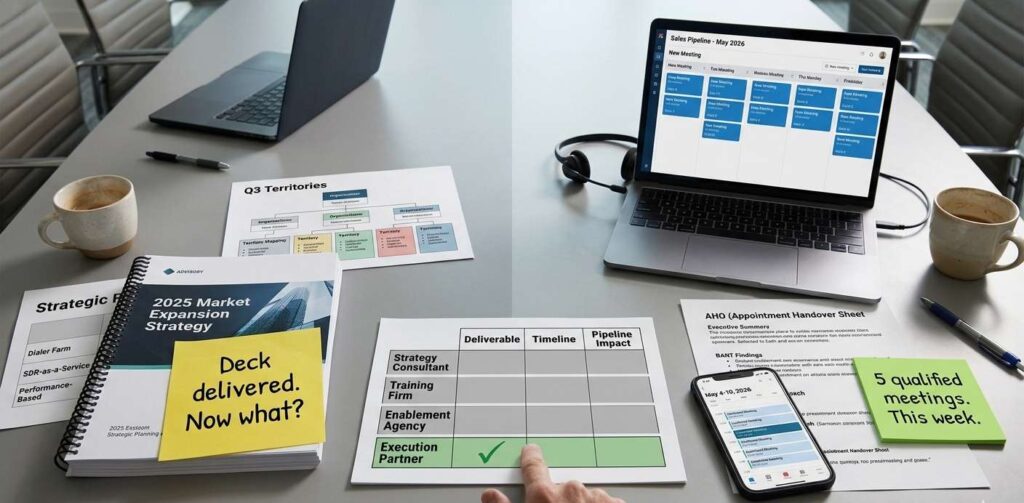


The B2B sales consulting market has expanded significantly over the past five years. Driven by rising customer acquisition costs, increasingly complex buying committees, and the pressure to demonstrate measurable pipeline ROI, companies are looking for external expertise that goes beyond generic advice. The challenge is that “consulting” and “agency” are umbrella terms that mask very different service models with very different outcomes.

Most B2B teams lose 40–60% of qualified prospects to broken handoffs and weak qualification. Take our 2-minute diagnostic to find out where your pipeline is bleeding — and how to fix it.
Start the Quiz → Takes 2 minutes. No email required to start.This guide provides a taxonomy of B2B sales service providers, explains what you should realistically expect from each, gives you a buyer’s checklist for evaluating proposals, and addresses the central question every buyer should ask: Are they handing you a deck, or a pipeline?
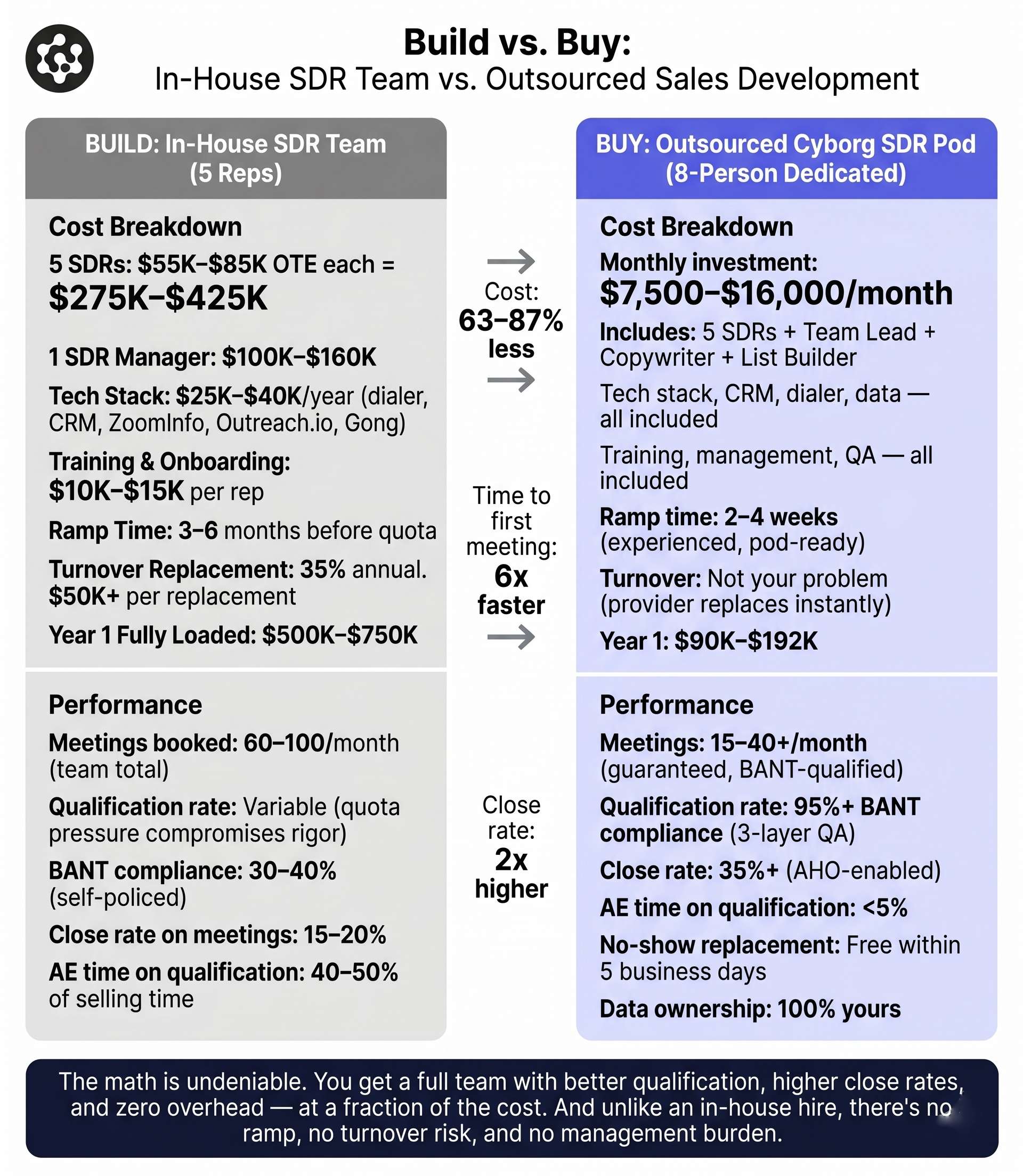
The Four Types of B2B Sales Service Providers
Type 1: Strategy Consultants
Firms like McKinsey, Bain, or specialized boutiques that analyze your go-to-market motion, build territory models, design compensation plans, and deliver a strategy document. They bring deep analytical rigor, access to benchmark data, and frameworks tested across hundreds of engagements. They do not execute.

Typical engagements run $150,000–$500,000+ for a 6–12 week project. These firms are appropriate when you need to fundamentally redesign your sales motion, restructure territories, enter a new market, or navigate a major transition (PLG to sales-led, SMB to enterprise, domestic to international). They are not appropriate when your problem is execution—having a beautiful GTM strategy deck does not produce pipeline.
The gap between strategy and execution is where most consulting engagements fail to deliver ROI. The consultant delivers a 120-page playbook. The internal team reads the executive summary. Three months later, the playbook sits in a shared drive while the team reverts to previous habits. If you engage a strategy consultant, budget for internal execution resources (or an execution partner) to implement the recommendations.

Type 2: Sales Training Firms
Providers like Sandler, Challenger, JBarrows, or Pavilion who deliver sales training programs to improve your existing team’s capabilities. Training firms teach methodologies, run workshops, provide coaching cadences, and certify reps on specific selling frameworks.
They improve the skills of the people you already have but do not generate pipeline directly. Budget ranges from $5,000 for an online program to $50,000+ for on-site custom workshops with ongoing coaching and certification. The best training firms include post-workshop reinforcement (weekly coaching calls, call reviews, manager enablement) because training without reinforcement has a 90-day forgetting curve—most reps revert to old habits within a quarter if skills are not continuously coached.
Training is most valuable when you have a solid sales process but your reps are not executing it effectively. If the process itself is broken, training improves the skills applied to a bad system—which is like teaching someone to drive faster on a road that leads to the wrong destination.
Type 3: Sales Enablement Agencies
Agencies that build the infrastructure around your sales team: CRM implementation and optimization, sales playbook creation, content development for each stage of the buyer journey, tool selection and integration, and sales enablement technology configuration.
They optimize the machine but do not operate it. Engagements are typically project-based ($20,000–$100,000 for a CRM overhaul or playbook build) or retainer-based ($5,000–$15,000/month for ongoing content, tool management, and process optimization). Enablement agencies work best when your team has the right people and the right process but lacks the infrastructure to support them—missing playbooks, broken CRM workflows, inadequate content for specific buyer stages, or a disconnected tech stack.
Type 4: Execution Partners (Pipeline-as-a-Service)
Execution partners take ownership of a specific pipeline outcome: prospecting, qualification, and appointment delivery. They don’t advise you on what to do—they do it. The deliverable is not a recommendation; it is meetings on your AE’s calendar with verified qualification data attached.
DemandNexus operates in this category. The Cyborg SDR pod model combines AI-powered research (intent monitoring across six owned media brands reaching 15M+ decision-makers monthly, automated list building, A/B message testing) with human-led qualification (BANT-verified calls scoring each element 1–5) to deliver appointments backed by structured Appointment Handover Sheets (AHOs). Each AHO includes the prospect’s verified budget status, authority mapping, specific pain points in their own words, timeline with forcing events, competitor intelligence, and a recommended opening for the AE.
The pricing is performance-based across three tiers (Essentials, Growth, Enterprise)—you pay for qualified outcomes, not headcount or hours of advice. If a meeting doesn’t meet the agreed qualification criteria, it’s replaced at no cost.
The pivotal distinction: strategy consultants, trainers, and enablement agencies all deliver inputs to your sales process. Execution partners deliver outputs. Both have value, but confusing them leads to misallocated budget and unmet expectations.
Wondering which type of sales investment would move your pipeline fastest? Take the assessment.
How to Evaluate a B2B Sales Agency: The Buyer’s Checklist
Not all agencies that call themselves “B2B sales consulting” or “B2B sales agency” deliver the same thing. Use this checklist to cut through the positioning and evaluate what you’re actually getting:
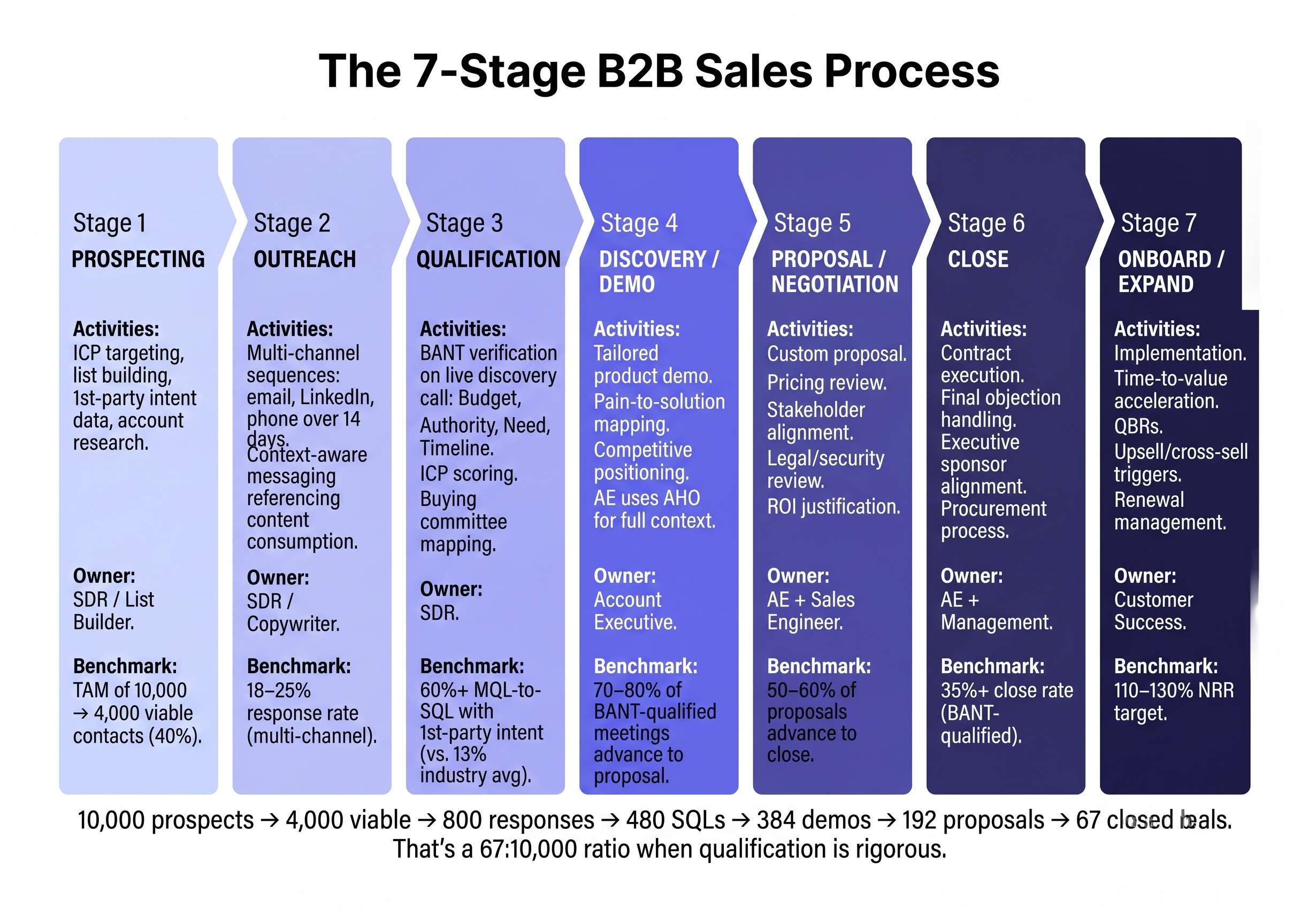
- Deliverable clarity: Ask “What exactly will my AE receive?” A calendar invite with the prospect’s name is not a deliverable. A structured handover document with qualification data, verbatim quotes, competitor intel, and a recommended approach is a deliverable. If they cannot describe what your AE receives before a meeting in specific detail, their process is not rigorous enough to produce consistent results.
- Qualification methodology: If they can’t describe a structured qualification framework with specific scoring criteria, minimum thresholds, and a QA process, their “qualification” is subjective. Ask: What does a “qualified” meeting mean to you? How do you score it? What disqualifies a prospect?
- Data source: How do they identify target accounts? First-party intent data is gold—it means they have proprietary insight into who is actively researching your solution category. Purchased lists are copper—every competitor has access to the same data. Ask where their intelligence comes from and whether it’s proprietary or shared.
- Pricing model alignment: Retainer-based models transfer risk to you. Performance-based models share it. If a provider won’t tie their compensation to outcomes, they’re not confident in their ability to produce them. The pricing model reveals the provider’s confidence in their own process.
- Client references in your ACV range: A provider that delivers for $20K ACV SaaS companies may not have the methodology for $200K enterprise deals. The qualification rigor, buyer committee complexity, and sales cycle dynamics are fundamentally different. Ask for references that match your deal size, industry, and sales complexity.
- Quality guarantee: Do they replace meetings that don’t meet qualification criteria? Providers who stand behind their output signal confidence. Those who don’t are selling volume, not quality. A replacement policy is the strongest signal that the provider actually believes in their qualification process.
- Transparency and reporting: What reporting will you receive? Weekly dashboards, call recordings, pipeline analytics, and AE feedback tracking are hallmarks of a mature operation. “We’ll send you a monthly summary” is not sufficient for a partnership that directly impacts your pipeline.
Budget Ranges and Expected Timelines by Provider Type
Understanding the economics helps you compare apples to apples:
Strategy consulting: $150K–$500K+. Timeline: 6–12 weeks to deliverable, 3–6 months to measurable pipeline impact (assuming the strategy is actually executed by your team or an execution partner). ROI is indirect and delayed.
Sales training: $5K–$50K per program. Timeline: immediate delivery, but 3–6 months to measurable behavior change with reinforcement. Without reinforcement, expect skill regression within 90 days.
Enablement agencies: $20K–$100K project or $5K–$15K/month retainer. Timeline: 4–12 weeks to infrastructure, indirect pipeline impact. ROI is operational efficiency rather than direct revenue.
Execution partners: $800–$2,500 per qualified appointment (performance-based). Timeline: 30–60 days to first meetings, direct pipeline impact from month one. ROI is measurable in pipeline value and SQL conversion rates from the first batch of meetings.
The budget question is not “How much can we spend?” but “What pipeline outcome do we need, and which provider model delivers that outcome most efficiently?” If you need more qualified meetings this quarter, an execution partner is the fastest path. If you need to redesign your entire GTM architecture, a strategy consultant may be warranted—but understand that the pipeline impact is months away.
Common Mistakes When Hiring B2B Sales Consultants
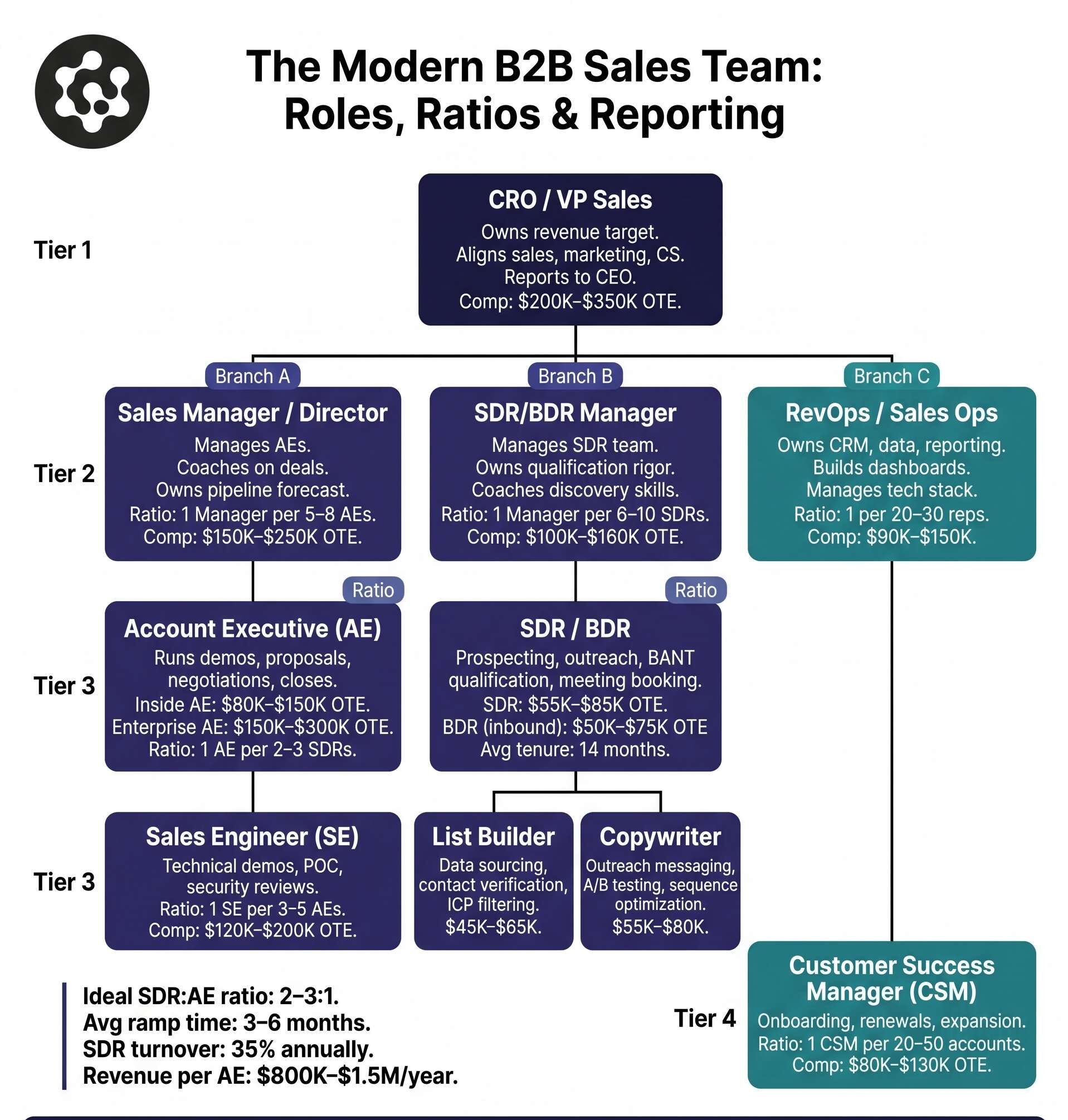
Hiring strategy when you need execution. If your team knows what to do but struggles to do it at scale, a strategy consultant will tell you what you already know in a prettier format. You need hands that do the work, not more advice.
Expecting training to fix a process problem. If your sales process is undefined or broken, training your reps on better techniques improves their skills within a dysfunctional system. Fix the process first, then train.
Choosing based on brand name alone. Prestigious consulting firms are not automatically the best fit for a $5M ARR SaaS company. Their frameworks are built for enterprise at scale. Match the provider’s experience to your stage, ACV, and complexity.
Not defining success criteria upfront. If you cannot articulate what a successful engagement looks like in measurable terms (X qualified meetings, Y SQL conversion rate, Z pipeline value) before signing the contract, you’ll have no way to evaluate whether the investment paid off.
Book a 45-minute call to see what performance-based pipeline delivery looks like.
FAQs
What does a B2B sales consultant do?
A B2B sales consultant advises companies on sales strategy, process design, team structure, and go-to-market execution. Services range from strategic advisory (framework design, territory planning, compensation modeling) to hands-on execution (prospecting, qualification, appointment setting). The scope depends on whether you engage a strategy consultant, training firm, enablement agency, or execution partner—each type delivers fundamentally different outcomes.
What is the difference between a sales agency and a sales consultant?
A sales consultant provides advisory services—strategy, analysis, and recommendations that your team then executes. A sales agency typically provides execution services—prospecting, outreach, qualification, and meeting delivery—handled by the agency’s team on your behalf. Consultants hand you a plan; agencies hand you pipeline. Some firms offer both, but the core distinction is whether you receive advice or outcomes.
How much does a B2B sales consultant cost?
Costs vary dramatically by provider type. Strategy consultants charge $150K–$500K+ for project-based engagements. Training firms charge $5K–$50K per program. Enablement agencies charge $5K–$15K per month on retainer. Execution partners charge $800–$2,500 per qualified appointment on a performance basis. The right comparison is cost-per-outcome (pipeline generated), not cost-per-hour.
What should you expect from a B2B sales agency?
Expect clear qualification criteria agreed upon before the engagement starts, structured handover documentation for every meeting, transparent reporting on activity metrics and conversion rates, a quality guarantee (replacement policy for meetings that don’t meet criteria), and a pricing model that aligns their incentives with your outcomes. If any of these are missing, you’re taking on more risk than necessary.
Are B2B sales consultants worth it?
It depends on the match between your need and the provider type. If your sales process, strategy, or team structure needs fundamental redesign, a consultant can provide the framework. If your problem is pipeline volume and meeting quality, an execution partner delivers faster and more directly measurable ROI. The most common mistake is hiring a consultant when you need an executor, or vice versa.