
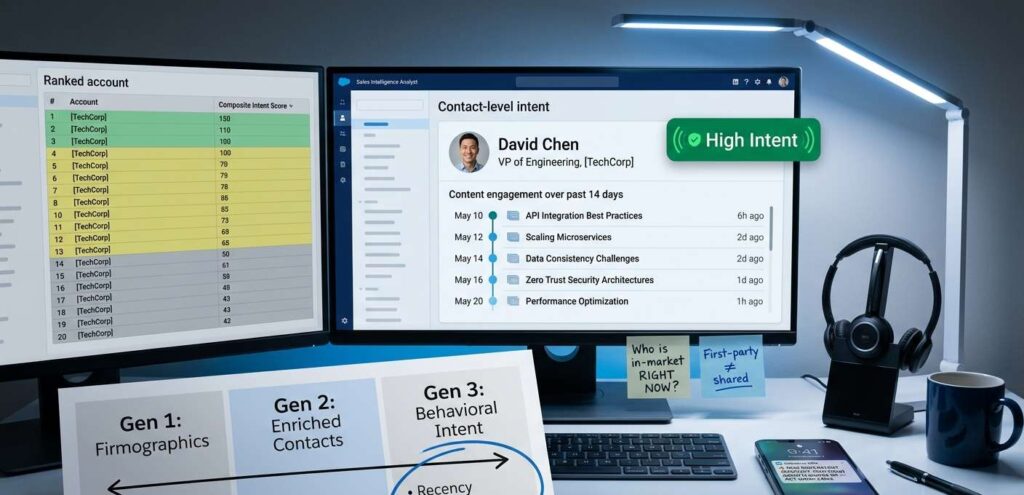


For most of the past decade, “sales intelligence” has been synonymous with contact databases—platforms like ZoomInfo, Apollo, and Lusha that provide verified contact information for prospecting. These tools solved the “who do I call?” problem. They did not solve the “who should I call right now?” problem. That distinction is the defining shift in sales intelligence for 2026, and it represents the difference between activity-based selling (work the list from top to bottom) and intelligence-driven selling (engage the accounts showing buying behavior today).

Most B2B teams lose 40–60% of qualified prospects to broken handoffs and weak qualification. Take our 2-minute diagnostic to find out where your pipeline is bleeding — and how to fix it.
Start the Quiz → Takes 2 minutes. No email required to start.Three Generations of Sales Intelligence
Generation 1: Static Firmographics (2005–2015)
The first generation of sales intelligence tools provided company databases with firmographic filters: industry, size, location, revenue. Sales teams would build lists based on these attributes, buy contact data for the resulting accounts, and begin outreach. The data was better than nothing—it replaced phone books and manual research—but it was static. It told you which companies matched your ideal customer profile, not which ones were ready to buy.
The limitation of Gen 1 tools was that they treated all ICP-fit accounts as equally worth pursuing. A perfect firmographic match that has no active need is just as likely to ignore your outreach as a company that doesn’t match your ICP at all. Fit without timing produces volume, not conversions.
Generation 2: Enriched Contacts + Triggers (2015–2022)
The second generation added contact enrichment (direct dials, verified emails, job titles, LinkedIn profiles) and trigger events (funding rounds, leadership changes, job postings, technology installations). Platforms like ZoomInfo, Cognism, and Apollo became essential components of the B2B sales tech stack. These triggers improved timing—you could reach out when a company was hiring a VP of Sales or had just raised a Series B—but they were still based on public signals available to every competitor using the same tools.
The problem with Gen 2 intelligence is that it is commoditized. If every sales team in your category uses ZoomInfo and monitors the same trigger events, the data provides no competitive advantage. The prospect receives outreach from five competitors within 48 hours of any public trigger event. Speed matters, but parity data means parity results.
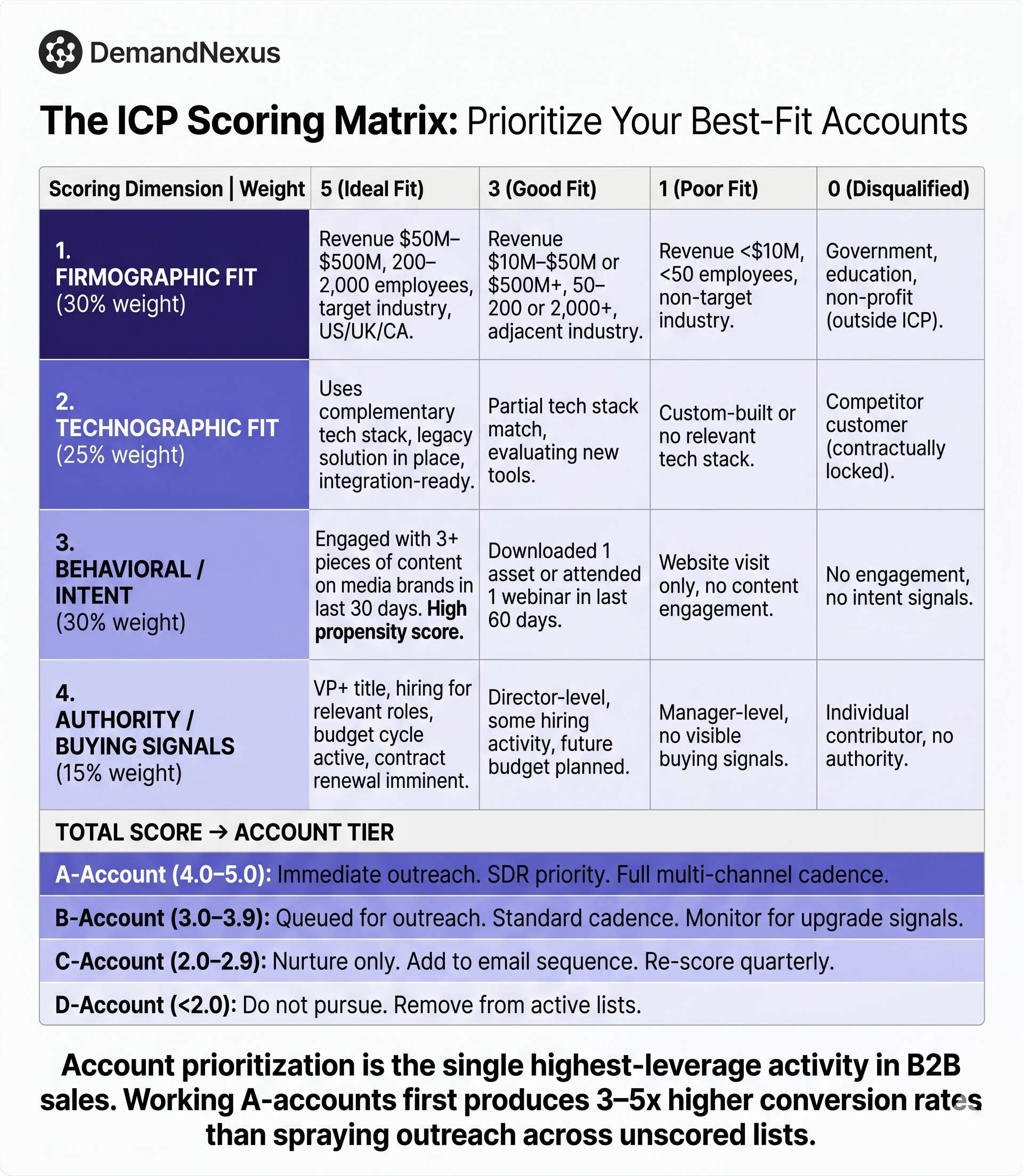

Generation 3: Behavioral Intent + First-Party Data (2022–Present)
The current generation of sales intelligence incorporates behavioral intent data: signals about what prospects are actively researching, which topics they’re consuming content about, and how their engagement patterns suggest buying readiness. This is the category where the competitive advantage shifts from “who do I know?” to “who is in-market right now?”
The critical distinction within intent data is first-party vs. third-party. Third-party intent data (from providers like Bombora, G2, or TrustRadius) is aggregated from multiple sources, anonymized to company-level, shared across subscribers, and often delayed by days or weeks. First-party intent data comes from audiences you own—your website, your content platforms, your media properties—and is proprietary, real-time, contact-level, and not shared with competitors.
DemandNexus generates first-party intent signals from six owned B2B media brands—AITechTrend (4.7M monthly readers, AI and machine learning), MarTechTrend (3.2M, marketing technology), DevTechTrend (1.8M, developer tools), HRTechTrend (2.1M, HR technology), FinTechFilter (1.7M, financial technology), and LegalTechTrend (1.5M, legal technology)—reaching over 15 million decision-makers monthly.
When a VP of Engineering reads three articles about API integration challenges on DevTechTrend in a two-week window, that’s a verified, specific, and proprietary signal. The system knows who the person is (not just “someone at Acme Corp”), what they’re researching (not just “technology topics”), and how recently (not a signal from weeks ago). This feeds directly into the prospecting and qualification process, giving SDRs the context to open conversations with “I noticed you were researching API integration challenges” rather than “Hi, do you have 30 seconds?”
See how first-party intent data changes your pipeline economics.
Buyer’s Guide: What to Look for in a Sales Intelligence Platform
Data accuracy and freshness: Contact data decays at roughly 30% per year. Job changes, company restructuring, and email domain changes make yesterday’s data unreliable tomorrow. Ask providers about their verification process, data refresh cadence, and accuracy guarantees. The best practice is to test a sample of 100 contacts before committing to an annual contract.
Intent data source and methodology: Is the intent data first-party (proprietary) or third-party (aggregated and shared)? If third-party, how many other companies subscribe to the same data? Is the intent signal contact-level or company-level? Contact-level intent (“Jane Smith is researching X”) is dramatically more actionable than company-level intent (“Someone at Acme Corp is researching X”).
Integration depth: Does the platform integrate natively with your CRM and sales engagement tools? Manual export/import processes create friction and data lag. The best intelligence platforms push signals directly into your SDR’s workflow so they appear in the CRM as tasks or prioritized account lists.
Compliance and privacy: GDPR, CCPA, and evolving privacy regulations affect how prospect data can be collected and used. Ensure the provider has compliant data sourcing practices, clear opt-out mechanisms, and can document the legal basis for the data they provide. This is especially critical for EMEA-focused outreach.
Signal-to-noise ratio: A platform that surfaces 10,000 intent signals per week without prioritization creates noise, not intelligence. Look for scoring, segmentation, and recommended-action features that translate raw data into an SDR’s daily workflow. The platform should help your team work smarter, not drown them in more data.
Sales Intelligence vs. CRM: Complementary Systems
A CRM (Salesforce, HubSpot, Pipedrive) is a system of record—it stores and organizes data about your existing pipeline, deals, and customer relationships. Sales intelligence is a system of insight—it provides data about accounts and contacts you haven’t engaged yet, or that are showing new buying signals.
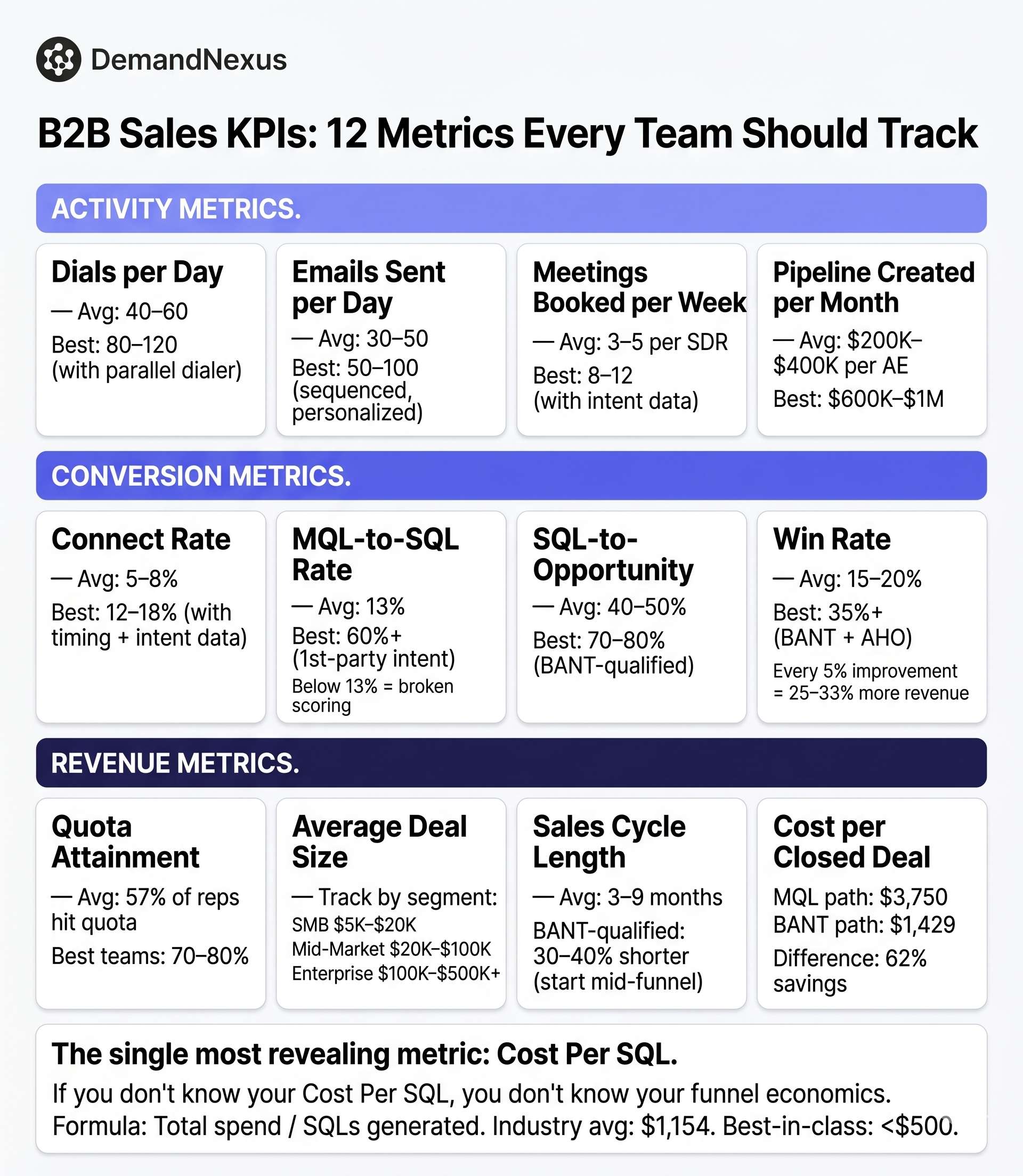
The two are complementary, not competitive. Sales intelligence feeds new target accounts and intent signals into your CRM. Your CRM tracks what happens after engagement. The gap most teams have is not in CRM adoption (most B2B companies use one) but in the quality and recency of the data flowing into it. A CRM populated with stale data from a list purchased six months ago is a database of dead ends, not a pipeline management tool.
The integration point matters: intent signals should surface inside the CRM as real-time alerts, updated account scores, or prioritized task lists—not as a separate dashboard the SDR has to remember to check.
The First-Party Data Advantage: Why Bought Intent Is Losing Its Edge
Third-party intent data has hit diminishing returns for three structural reasons:
It is shared. If you and your three closest competitors all subscribe to the same intent provider, the data provides no competitive advantage. You’re racing competitors to the same accounts with the same signals—and the prospect receives outreach from five vendors within the same week.
It is aggregated and anonymized. Third-party signals report that “someone at Acme Corp is researching your category.” This company-level signal is less actionable than knowing that “Jane Smith, VP of Sales at Acme Corp, read three articles about pipeline optimization on MarTechTrend in the past 10 days.” Contact-level, topic-specific, recency-verified signals produce categorically different outreach quality.
It is delayed. By the time aggregated intent data reaches your SDR, the prospect may have already moved on or been contacted by competitors who had faster access to the same signal. Real-time, first-party signals trigger outreach within hours, not days.
First-party intent data solves all three problems. It is proprietary (your competitors don’t have it), specific (you know the person, the topic, and the recency), and real-time (the signal triggers outreach immediately). This is why teams using first-party intent in their qualification process report 202% higher close rates compared to those relying on demographic targeting alone—and why the cost-per-qualified-appointment from intent-driven outreach is typically 40–60% lower than the cost from channel advertising.
12 Sales Intelligence Tools Worth Evaluating
The sales intelligence market includes dozens of tools. Here are the categories and leading platforms by function:
Contact databases: ZoomInfo (broadest database, $15K+/yr), Apollo (contact + sequencing in one, $5K+/yr), Cognism (EMEA-strong, compliance-focused), Lusha (lightweight, contact enrichment).
Technographic intelligence: BuiltWith (website technology profiles), HG Insights (technology install data at scale), Datanyze (competitive tech stack monitoring).
Intent data platforms: Bombora (largest third-party co-op), 6sense (predictive account intelligence), G2 (buyer intent from software review activity), TrustRadius (verified review + intent).
First-party intent + execution: DemandNexus (proprietary intent from 6 owned media brands + BANT-qualified appointment delivery). This category is distinct because it combines the intelligence layer with the execution layer—rather than providing data for your team to act on, the provider acts on the data and delivers the outcome.
The tool selection should map to your team’s maturity. If you don’t have basic contact data, start with a database. If you have contacts but poor timing, add intent. If you have intent but poor execution, consider a provider that bundles intelligence with sales outsourcing.
Ready to see what first-party intent reveals about your target accounts?
Key Takeaways
Sales intelligence has evolved through three generations: static firmographics, enriched contacts with triggers, and behavioral intent data. The current frontier is first-party intent—proprietary, real-time, contact-level signals from audiences you own. Third-party intent data is useful but commoditized—everyone has access to the same signals.
The most effective sales intelligence strategy in 2026 combines first-party intent for competitive advantage with enriched contact data for execution, integrated into your CRM workflow so SDRs act on signals the same day they appear. And for teams that want to skip the tool-selection phase entirely, execution partners that bundle intelligence with qualification and appointment delivery provide the most direct path from signal to pipeline.