


This guide walks through a seven-stage B2B sales process framework, with specific activities, metrics, tools, and exit criteria for each stage. It is designed for mid-market and enterprise sales teams with deal sizes above $25,000 ACV and sales cycles of 30–180 days.

Most B2B teams lose 40–60% of qualified prospects to broken handoffs and weak qualification. Take our 2-minute diagnostic to find out where your pipeline is bleeding — and how to fix it.
Start the Quiz → Takes 2 minutes. No email required to start.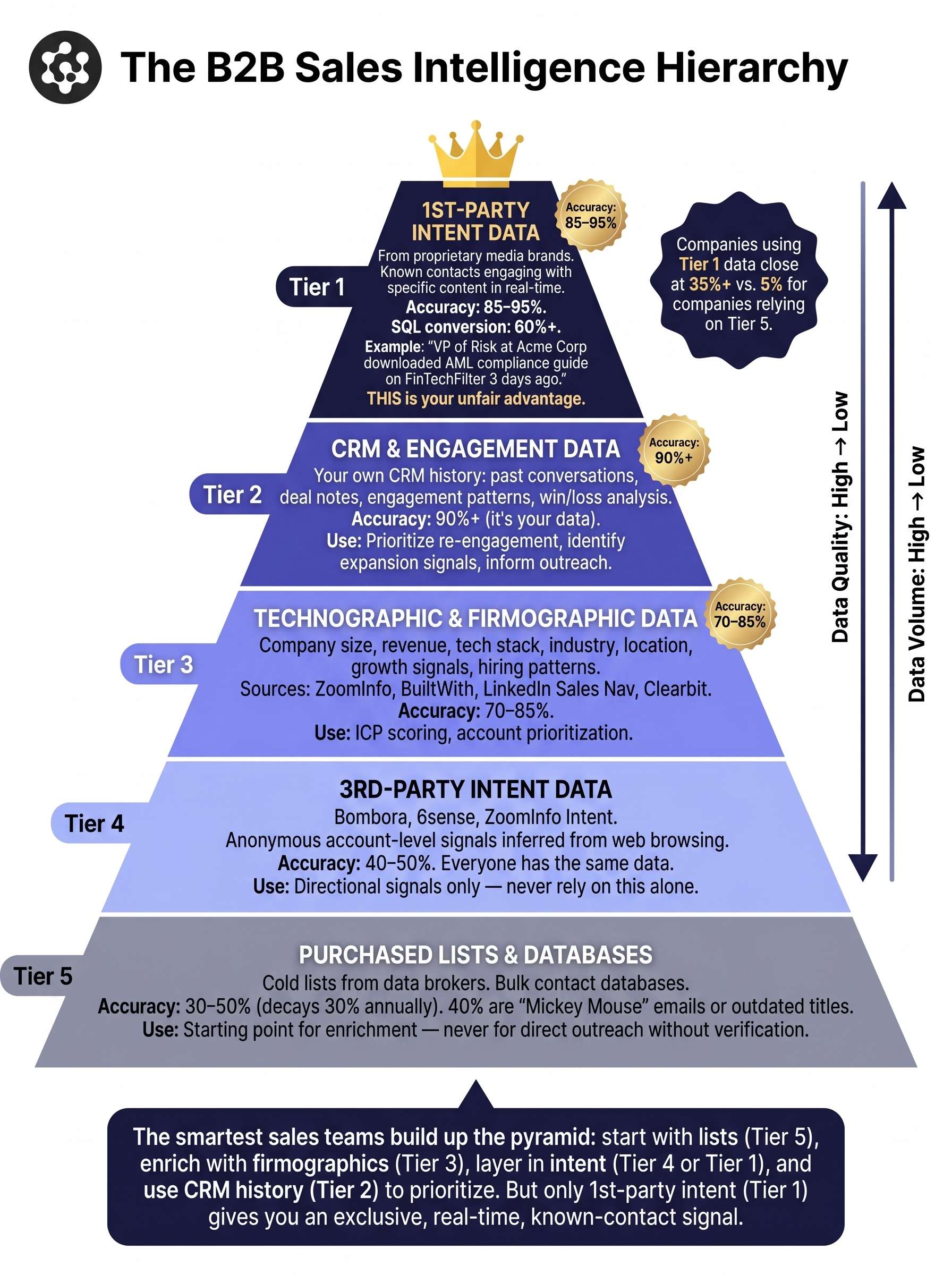
The Seven Stages of the B2B Sales Process
Stage 1: Prospect
Prospecting is the act of identifying accounts and contacts that match your ideal customer profile. This stage combines ICP-based list building with intent signal monitoring to prioritize accounts showing active buying behavior.
Activities: Define ICP criteria, build target account lists, monitor intent signals, research accounts, identify buying committee members.

Exit criteria: Account matches ICP, at least one contact identified with a valid communication channel, account shows intent signals or matches a trigger event.
Key metric: Accounts researched per week, accounts meeting ICP threshold per week.

Stage 2: Connect
Connection is the first meaningful interaction with a prospect. This is where multi-channel outreach cadences combine email, phone, LinkedIn, and targeted content to establish initial contact.
Activities: Execute outreach cadence, personalize messaging based on intent signals and account research, handle initial objections, secure a discovery conversation.
Exit criteria: Prospect has agreed to a discovery conversation or qualification call.
Key metric: Connect rate, positive response rate, meetings booked per 100 outreach attempts.
Stage 3: Qualify
Qualification is the most critical stage in the process—and the one most teams do poorly. This is where BANT verification separates prospects who are ready to buy from those who are just browsing.
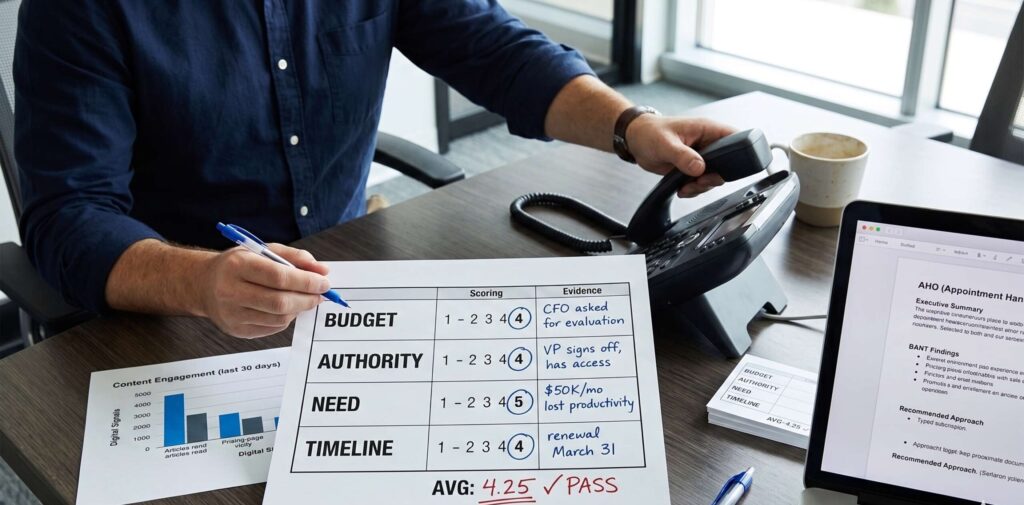
Activities: Conduct structured qualification call, score Budget, Authority, Need, Timeline on a 1–5 scale, document findings, produce Appointment Handover Sheet (AHO) if the prospect passes.
In the Waterfall model, qualification is not a checkbox exercise. It is a human-led consultation where the SDR probes each BANT element, documents verbatim quotes, identifies objections, and provides the AE with a structured handover that includes specific pain points, competitor intelligence, and a recommended approach. This is why AEs who receive an AHO report 90%+ show rates and dramatically higher close rates compared to standard meeting handoffs.
Exit criteria: Minimum 4.0 average BANT score, AHO completed and delivered to AE 24–48 hours before the meeting.
Key metric: Qualification rate (% of connects that pass BANT), AHO delivery rate, AE acceptance rate.
Stage 4: Discover
Discovery is the AE’s first meeting with the qualified prospect. Unlike traditional discovery calls where the AE starts from zero, an AE who has received an AHO walks in already knowing the prospect’s pain points, budget range, decision process, and timeline.
Activities: Validate and deepen BANT findings, map the buying committee, understand the evaluation criteria, identify potential deal blockers, align on next steps.
Exit criteria: Mutual agreement on the problem to solve, evaluation criteria understood, next step (demo, proposal, or technical evaluation) confirmed.
Key metric: Discovery-to-demo conversion rate, average discovery call duration.
Stage 5: Present
The presentation or demo stage is where you show—don’t just tell—how your solution addresses the prospect’s specific pain points. The best demos are tailored to the pain points uncovered in discovery, not generic product tours.
Activities: Deliver tailored sales pitch or demo, address specific use cases, involve relevant stakeholders, handle technical questions.
Exit criteria: Prospect confirms the solution addresses their needs, requests proposal or next-step action.
Key metric: Demo-to-proposal conversion rate.
Stage 6: Propose
The proposal stage formalizes the commercial terms: pricing, scope, timeline, implementation plan, and contractual conditions. Strong proposals reference the specific pain points and ROI discussed during discovery—they are not generic templates with a logo swap.
Activities: Create tailored proposal, negotiate terms, address procurement and legal requirements, handle objections.
Exit criteria: Verbal agreement on terms, procurement/legal process initiated.
Key metric: Proposal-to-close conversion rate, average negotiation duration.
Stage 7: Close
Closing is the formal commitment: contract signed, purchase order issued, or payment processed. The close is not a single event but the culmination of every previous stage—and the smoothest closes happen when qualification was thorough and expectations were aligned throughout.
Activities: Finalize contract, coordinate handover to implementation/CS team, confirm success metrics.
Exit criteria: Contract executed, revenue booked.
Key metric: Win rate, average deal size, sales cycle length.
Where is your sales process leaking revenue? Take the free pipeline assessment.
Transactional vs. Enterprise: Process Variations
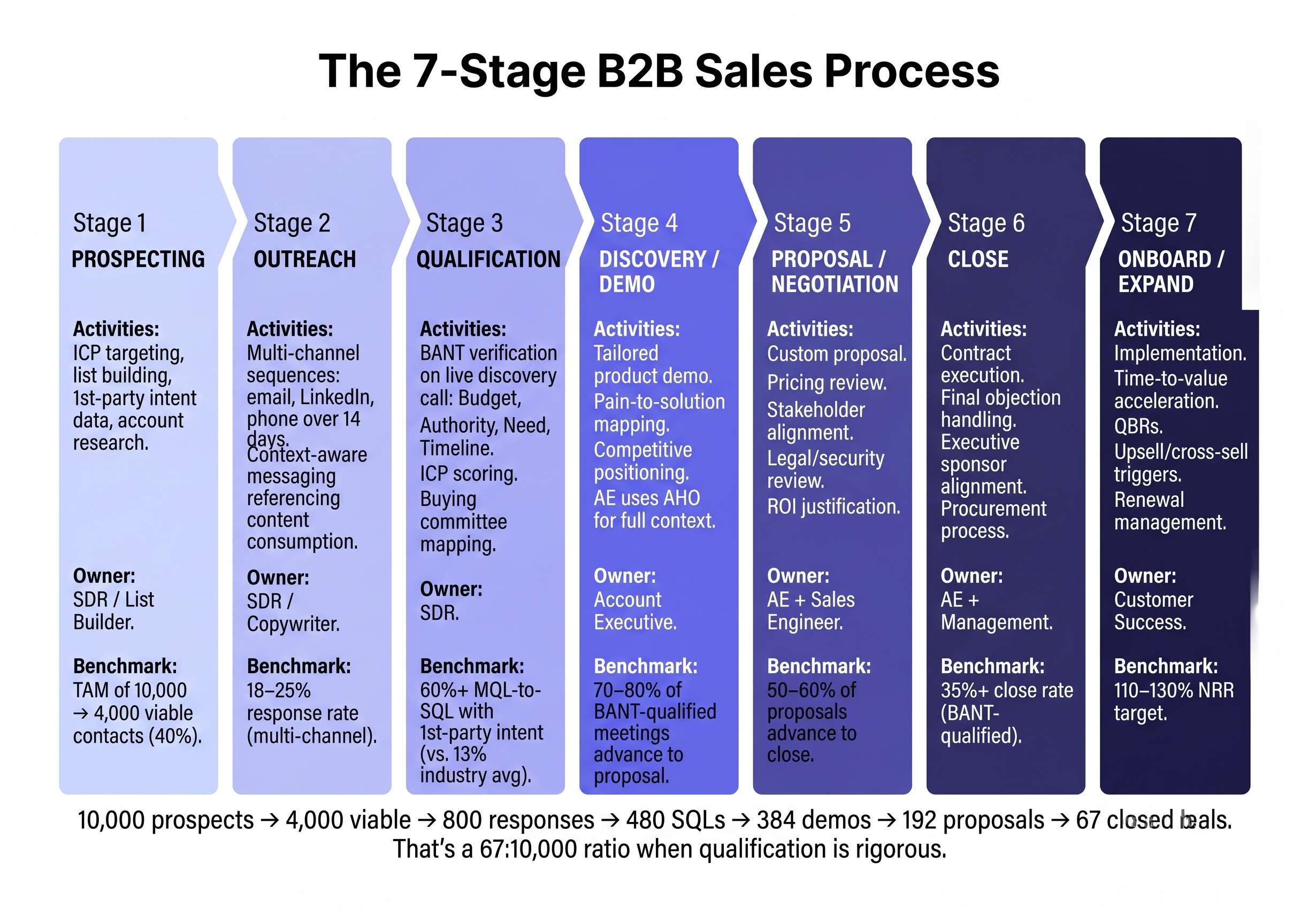
The seven-stage framework adapts to different deal complexities. Transactional sales (under $25K ACV, single decision-maker) may compress stages 4–6 into a single meeting. Enterprise sales ($100K+ ACV, 6–10 stakeholders, 6–12 month cycles) may expand stages 4–6 into multiple rounds of discovery, technical evaluation, security review, and executive alignment.
The stages don’t change—the depth and duration of each stage scales with deal complexity. What remains constant is the need for structured qualification at Stage 3. Whether the deal is $10K or $1M, an unqualified opportunity wastes the AE’s time and inflates pipeline metrics with phantom revenue.
The Qualification Stage Is Where Most Processes Fail
The single most common failure point in B2B sales processes is an inadequate qualification stage. Most teams either skip it entirely (SDR books a meeting and passes it to the AE with no qualification data), or execute it superficially (SDR asks one or two questions and marks the opportunity as qualified based on the prospect agreeing to a meeting).
The cost of this failure cascades through every subsequent stage. AEs waste time on unqualified meetings. Pipeline forecasts are inflated with opportunities that will never close. Win rates drop. Morale suffers. And the real cost—the opportunity cost of qualified meetings that could have been booked instead—is invisible but enormous.
Structured qualification with documented handover is not optional for a functional sales process. It is the mechanism that makes every downstream stage more efficient and every pipeline metric more reliable.
See what structured qualification looks like in practice.
FAQs
What are the 7 steps of the B2B sales process?
The seven stages are: (1) Prospect—identify ICP-fit accounts, (2) Connect—establish initial contact through multi-channel outreach, (3) Qualify—verify Budget, Authority, Need, and Timeline through a structured call, (4) Discover—deepen understanding of pain points and buying process, (5) Present—demonstrate how your solution addresses specific needs, (6) Propose—formalize commercial terms, and (7) Close—execute the contract.
How long is the average B2B sales cycle?
The average B2B sales cycle ranges from 30 days for transactional deals (under $25K ACV) to 6–12 months for enterprise deals ($100K+ ACV). The primary driver of cycle length is the number of stakeholders involved, the complexity of the evaluation process, and the procurement and legal review requirements. Companies that implement structured qualification at the top of the funnel typically report shorter cycles because unqualified opportunities are removed earlier.
What’s the difference between the B2B and B2C sales process?
B2B sales processes involve multiple stakeholders, longer evaluation periods, higher average deal values, and more rational (ROI-driven) purchase decisions. B2C sales are typically shorter, involve a single buyer, are more emotionally driven, and have lower transaction values. The B2B process requires formal stages for qualification, discovery, and proposal that are unnecessary in most B2C contexts.
What are the stages of a B2B sales pipeline?
A B2B sales pipeline typically includes these stages: Prospecting, Qualification, Discovery, Demo/Presentation, Proposal, Negotiation, and Closed-Won or Closed-Lost. Each stage has specific exit criteria that an opportunity must meet before advancing. Pipeline stages map to the sales process stages but are viewed from a management and forecasting perspective rather than a seller’s workflow perspective.
How do you build a B2B sales process?
Start by mapping your current buyer journey from first touch to closed deal. Define 5–7 stages with clear exit criteria for each. Establish a structured qualification methodology (like BANT) at the qualification stage. Document the activities, tools, and metrics for each stage. Train the team on the process, implement it in your CRM as pipeline stages, and create a feedback loop between AEs and SDRs to continuously improve.