


The demand generation category has exploded from a handful of tools five years ago to over 400 platforms today. This guide focuses on the tools that actually drive pipeline in 2026, organized by the job they do rather than arbitrary acronyms. Every tool below has been evaluated against the same criteria: does it measurably improve qualified pipeline, and is it worth the cost given current B2B CPL inflation.

Most B2B teams lose 40–60% of qualified prospects to broken handoffs and weak qualification. Take our 2-minute diagnostic to find out where your pipeline is bleeding — and how to fix it.
Start the Quiz → Takes 2 minutes. No email required to start.How to Choose the Right Demand Generation Tools
Before shopping, answer three questions. First, what is your current pipeline bottleneck? Missing accounts means you need better intent data. Low meeting show rates means you need better SDR tooling. Poor content performance means you need better content experience platforms. Do not buy tools that do not solve a bottleneck you have actually diagnosed.
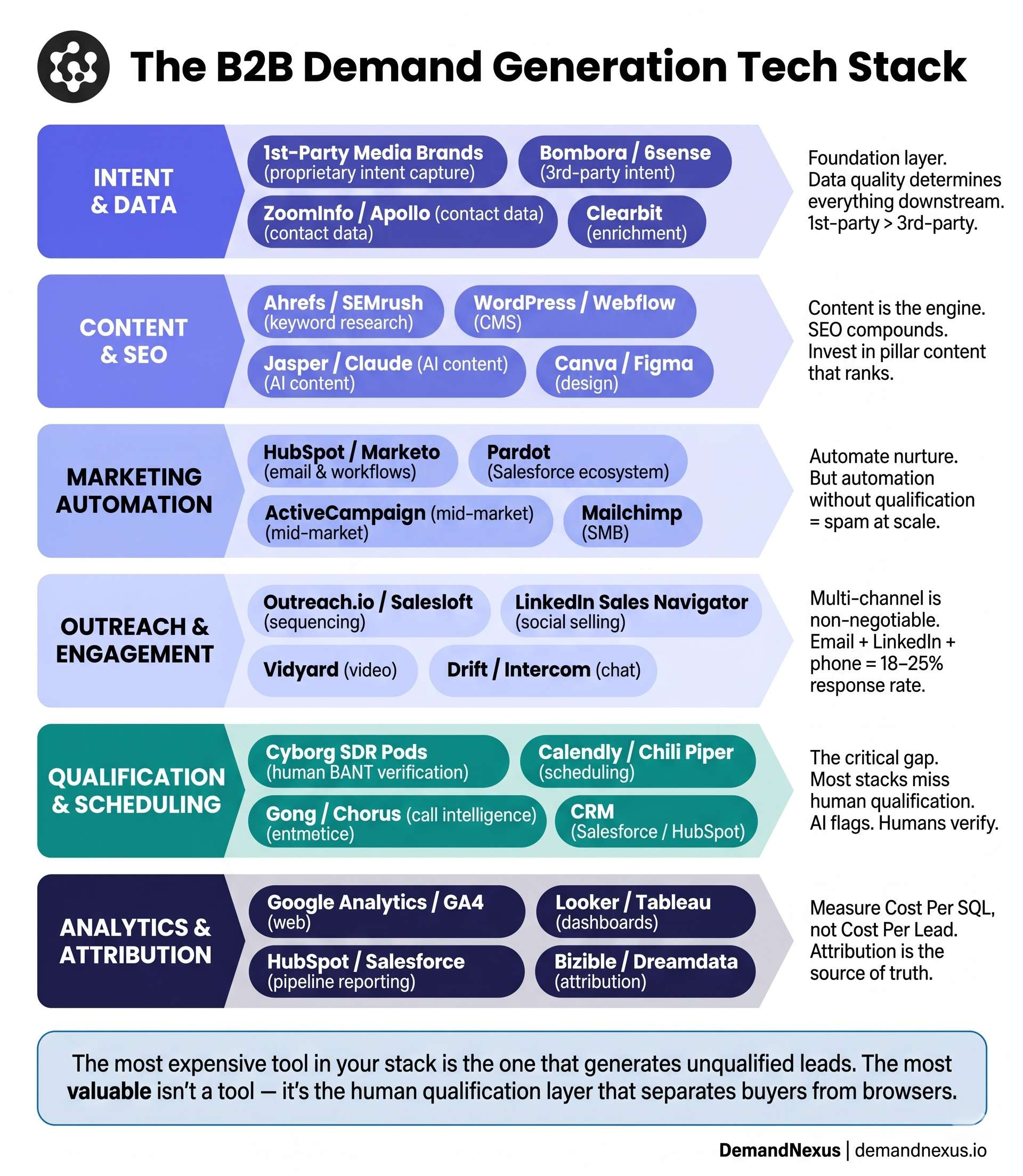
Second, what does your existing stack integrate with? A beautiful tool that does not pipe data into your Salesforce or HubSpot instance is friction your team will route around. Third, what does your team have capacity to operate? The best tool unused is worse than a decent tool your team actually runs.

Category 1: Intent Data Platforms
Intent data platforms identify which accounts are actively researching your category. They come in two flavors: third-party (buying signals from external publishers and networks) and first-party (signals from media properties you own or partner with).
| Tool | Category | Best For | Starting Price |
| Bombora | Third-party intent | Broad category coverage | $25K+ annual |
| 6sense | Predictive + intent platform | Enterprise ABM | $60K+ annual |
| Demandbase | Account intelligence + intent | ABM-driven teams | $50K+ annual |
| G2 Buyer Intent | Review-site intent | Bottom-funnel signals | $15K+ annual |
| ZoomInfo Intent | Contact data + intent | Full-funnel | $20K+ annual |
| TechTarget Priority Engine | Tech-category intent | B2B tech buyers | $25K+ annual |
| DemandNexus first-party intent | Owned-media intent | Teams needing signal no competitor has | Pay-per-appointment |
The structural problem with third-party intent in 2026 is that every competitor has access to the same signals. If Bombora sees a buying surge on your category, your competitors see it too. First-party intent from owned media brands, like the signals DemandNexus sources from its six B2B properties reaching 15 million decision-makers monthly, produces the kind of differentiation that third-party platforms cannot replicate.

Category 2: ABM Orchestration Platforms
| Tool | Best For | Starting Price |
| 6sense | Enterprise ABM with predictive AI | $60K+ annual |
| Demandbase | ABM + account intelligence | $50K+ annual |
| RollWorks | Mid-market ABM | $15K+ annual |
| Terminus | Multi-channel ABM | $30K+ annual |
| Madison Logic | Content-led ABM | $40K+ annual |
Category 3: SDR Enablement and Sales Engagement
| Tool | Best For | Starting Price |
| Outreach | Enterprise SDR teams | $100+ per user/month |
| Salesloft | Mid-market sales engagement | $125+ per user/month |
| Apollo | SMB and mid-market outbound | $59+ per user/month |
| Lemlist | Creative outbound at scale | $39+ per user/month |
| Gong | Revenue intelligence + call recording | $1,200+ per user/year |
| Chorus (by ZoomInfo) | Call intelligence | $1,500+ per user/year |
Category 4: Content Experience Platforms
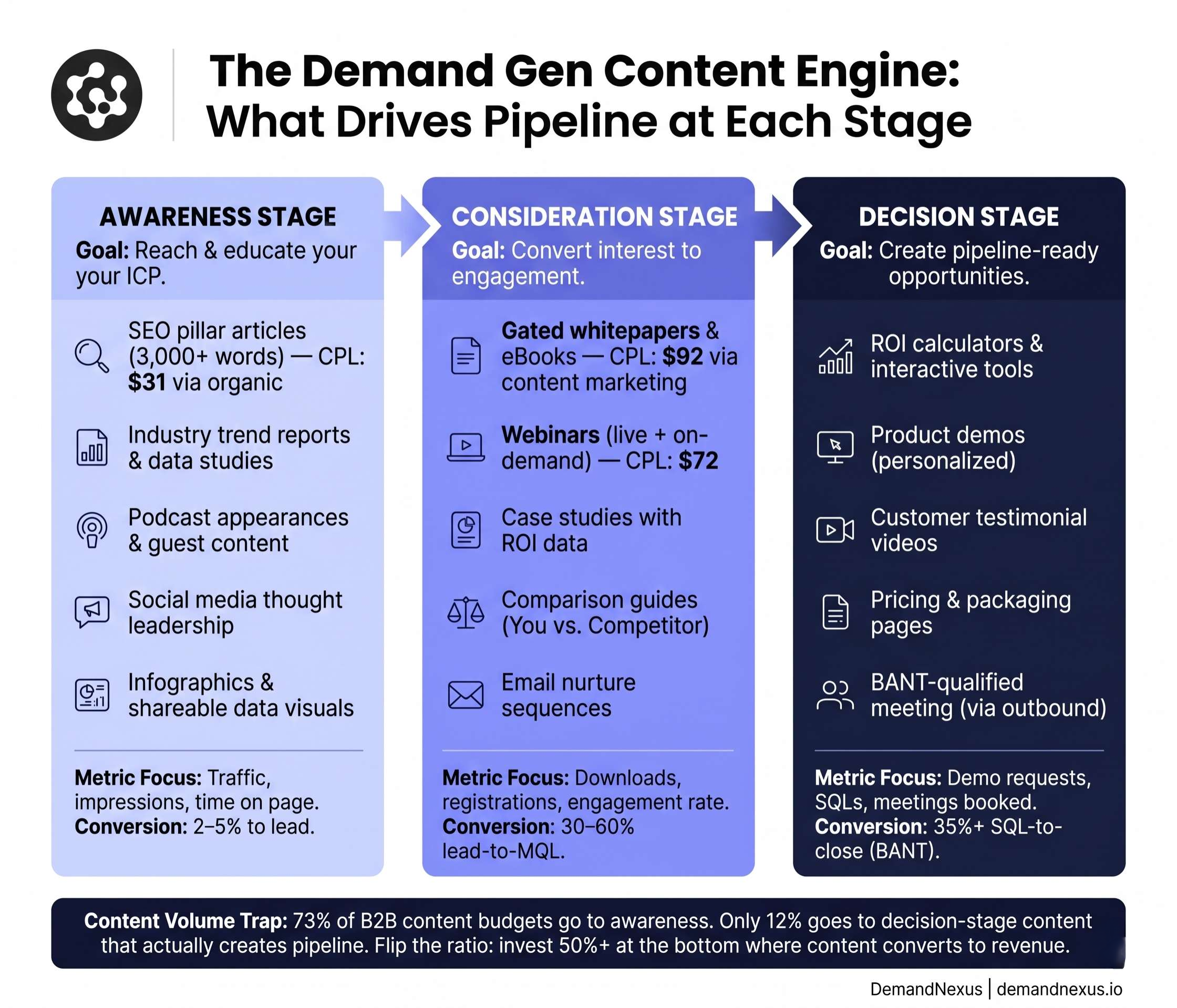
Content experience platforms (CEPs) are the category many teams confuse with content marketing tools. CEPs specifically manage how prospects interact with gated, ungated, and personalized content across their buying journey. The search query ‘most effective content experience platforms for b2b demand generation’ pulls hundreds of impressions monthly because the category is still being defined.
| Tool | Best For | Starting Price |
| PathFactory | Binge-worthy content streams | $30K+ annual |
| Uberflip | Content hubs with ABM personalization | $40K+ annual |
| Showpad | Sales enablement content | $45K+ annual |
| Highspot | Revenue enablement with content | $50K+ annual |
| Seismic | Enterprise content enablement | $60K+ annual |
| Mutiny | Website personalization | $30K+ annual |
The most effective content experience platforms for B2B demand generation combine three capabilities: personalized content recommendations based on firmographic and intent data, engagement analytics that feed back into the demand gen model, and deep integration with your CRM and marketing automation so content engagement can trigger qualification workflows.
Category 5: Event Intelligence Platforms
Event intelligence is one of the fastest-growing categories because webinar and event data is underutilized in most demand gen programs. The best event intelligence platforms for demand gen teams in 2026 that integrate with Salesforce and HubSpot share a common pattern: they turn raw event registrations into enriched, scored, and routed pipeline signals.
| Tool | Best For | Salesforce + HubSpot Integration |
| Goldcast | B2B webinars + event data | Native both |
| Zuddl | Hybrid and virtual events | Native both |
| Hopin (now RingCentral Events) | Large-scale virtual events | Native both |
| Splash | Event marketing + attendee intelligence | Native both |
| Bizzabo | Enterprise event platform | Native both |
| ON24 | Webinar engagement analytics | Native both |
Category 6: Competitor Intent and Competitive Intelligence
The best competitor intent tool for demand generation teams is not a single category winner but a set of complementary plays. Klue and Crayon dominate competitive intelligence briefings. G2 Buyer Intent surfaces accounts comparing you to competitors on review sites. Clearbit Reveal can de-anonymize website traffic from competitor-consideration pages.
| Tool | Specialization | Best For |
| Klue | Competitive intelligence and battlecards | Enterprise sales teams |
| Crayon | Competitive intel at scale | Mid-market to enterprise |
| G2 Buyer Intent | Comparison and consideration signals | Bottom-funnel intelligence |
| Clearbit Reveal | Website visitor identification | Traffic-heavy sites |
| SimilarWeb | Digital competitive benchmarking | Digital strategy teams |
Category 7: Revenue Analytics and Attribution
| Tool | Best For | Starting Price |
| HubSpot Marketing Hub | All-in-one mid-market | $890+ per month |
| Marketo Engage | Enterprise marketing automation | $40K+ annual |
| Salesforce Marketing Cloud | Enterprise Salesforce shops | Custom |
| Bizible (Marketo Measure) | Multi-touch attribution | $40K+ annual |
| Dreamdata | B2B revenue attribution | $30K+ annual |
| Rockerbox | Marketing measurement | $25K+ annual |
The DemandNexus View: Tools Are Not a Strategy
Here is the uncomfortable truth about demand generation tools. You can assemble the perfect stack (Bombora plus 6sense plus Outreach plus PathFactory plus Goldcast plus Marketo plus Bizible) and still miss plan. Tools execute strategy. They do not replace it.
The companies winning in 2026 are not the ones with the biggest stacks. They are the ones with the clearest qualification model. At DemandNexus we use AI-powered tools throughout the Cyborg SDR pod, but every qualified appointment still passes through human BANT verification before it reaches a client. That combination is what produces 90 percent plus meeting show rates and 60 percent plus SQL conversion, not any single tool.
If your tool stack is producing high MQL volume but low SQL conversion, the problem is upstream of tools. The demand generation quiz at demandnexus.io/start-quiz takes 90 seconds and diagnoses the root cause of most pipeline problems faster than any software evaluation.
How to choose: start from the funnel gap, not the feature list. Teams lacking awareness and engagement data lead with a content experience platform; teams that cannot see which accounts are in-market lead with an intent-data provider; teams scaling nurture lead with marketing automation.
FAQs
What is the best demand generation software for small teams?
For teams under 20 people, the most practical stack is HubSpot Marketing Hub paired with Apollo for outbound and G2 Buyer Intent for bottom-funnel signals. This covers automation, outreach, and intent without the enterprise pricing of 6sense or Demandbase.
How much should a demand gen tool stack cost?
Mid-market teams typically spend 8 to 15 percent of their marketing budget on tooling. A practical benchmark is $2,000 to $4,000 per SDR per year in tooling spend, excluding enterprise ABM platforms. If your tooling spend exceeds your headcount cost, the ratio is off.
Do I need a separate intent data tool if I have ZoomInfo?
ZoomInfo Intent covers third-party signals well but does not offer first-party intent from owned media properties. If your competitive differentiation depends on seeing signals others cannot see, layering first-party intent (such as from DemandNexus media properties) on top of ZoomInfo is what creates real edge.
What is the best all-in-one demand generation platform?
No true all-in-one exists in 2026. HubSpot and Salesforce Marketing Cloud come closest for mid-market and enterprise respectively, but both require supplementary tooling for intent, ABM orchestration, and content experience. Plan for a stack of 5 to 7 tools, not a single platform.
Which demand gen tools integrate best with Salesforce and HubSpot?
Most modern tools offer native integration with both. The event intelligence platforms (Goldcast, Zuddl, ON24, Splash, Bizzabo) all integrate natively with both, as do ABM platforms (6sense, Demandbase, RollWorks, Terminus) and sales engagement tools (Outreach, Salesloft). Integration depth varies, so ask for a Salesforce or HubSpot reference customer before purchasing.
What are the most effective content experience platforms for B2B demand generation?
The most widely adopted B2B content experience platforms are Uberflip, PathFactory, and Folloze. Each lets marketing teams build personalized content hubs grouped by persona, account, or buying stage, then track engagement to surface intent signals that demand-generation teams can act on.
What is the difference between demand generation tools and lead generation tools?
Demand generation tools build awareness and capture intent across the full buying journey, while lead generation tools focus on capturing contact details at a single conversion point. Demand generation feeds the top and middle of the funnel; lead generation converts that demand into identifiable contacts.
Do B2B teams need multiple demand generation tools or one platform?
Most B2B teams combine a marketing automation platform with an intent-data provider and a content experience layer, because no single tool covers awareness, intent, and conversion equally well. Mid-market teams often start with one all-in-one platform and add specialist tools as programs scale.
How much do B2B demand generation tools cost?
Pricing ranges from per-seat plans in the low hundreds of dollars per month for prospecting and automation tools, up to custom enterprise contracts for intent-data and ABM platforms, which are typically priced on account volume and data coverage.