


This guide compares cold calling and cold emailing across every dimension that matters for a B2B sales team: connect and response rates, cost per meeting, scalability, personalization, compliance, and effectiveness by buyer persona and deal size. It also covers how to combine the two channels into a cadence that outperforms either one alone.

Most B2B teams lose 40–60% of qualified prospects to broken handoffs and weak qualification. Take our 2-minute diagnostic to find out where your pipeline is bleeding — and how to fix it.
Start the Quiz → Takes 2 minutes. No email required to start.What Is Cold Calling vs Cold Emailing?
Cold calling is the act of phoning a prospect who has not previously expressed interest in your product or service. It is synchronous: the conversation happens in real time, which allows for immediate qualification and objection handling. Cold emailing is the act of sending an unsolicited email to a prospect. It is asynchronous: the prospect reads and responds on their own schedule, which allows for higher volume but slower feedback loops.
Both are forms of outbound prospecting. Both require accurate contact data, a compelling value proposition, and a clear qualification standard. The fundamental difference is the mode of interaction: cold calling forces a real-time human conversation, while cold emailing allows a prospect to engage at their own pace.
Cold Calling vs Cold Emailing: The Key Differences
The differences between cold calling and cold emailing break down across eight dimensions. On connect and response rates: cold calling connects on 4-6% of dials with a 2.3% meeting conversion rate on traditional programs (15-25% on intent-driven programs). Cold emailing achieves open rates between 25% and 45% and reply rates between 2% and 8% depending on personalization and deliverability.
On cost per meeting: cold calling is more expensive per touch but produces faster qualification. A fully loaded SDR making cold calls produces meetings at $800 to $1,500 each on traditional programs. Cold email can produce meetings at lower per-unit cost ($200 to $600) but requires more touches and longer cycles. On scalability: cold emailing scales more easily because a single SDR can send hundreds of personalized emails per day using sequencing tools, while cold calling is limited by talk time. On personalization depth: cold calling allows deeper real-time personalization and immediate adaptation to the prospect’s responses; cold email personalization is limited to what can be templated and merged.
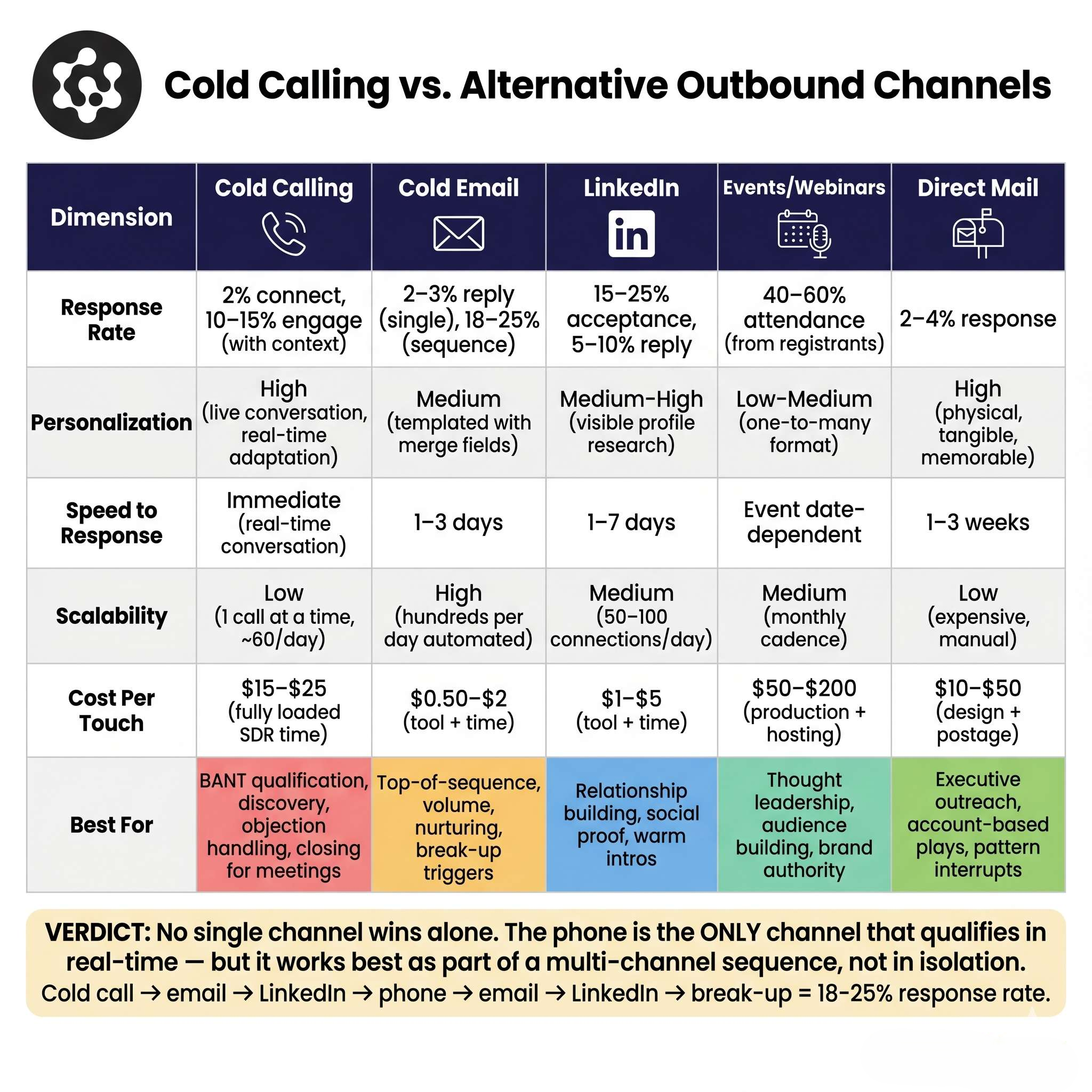

On qualification speed: cold calling can qualify (or disqualify) a prospect in a single conversation; cold email qualification requires multiple exchanges. On compliance: cold emailing faces stricter regulatory requirements in many jurisdictions (CAN-SPAM, GDPR, CASL) with specific opt-out and unsubscribe requirements. Cold calling has fewer regulatory hurdles in B2B contexts but requires compliance with TCPA and equivalent local regulations. For a complete guide to cold emailing best practices, see demandnexus.io/what-is-cold-emailing/.
When Cold Calling Works Better
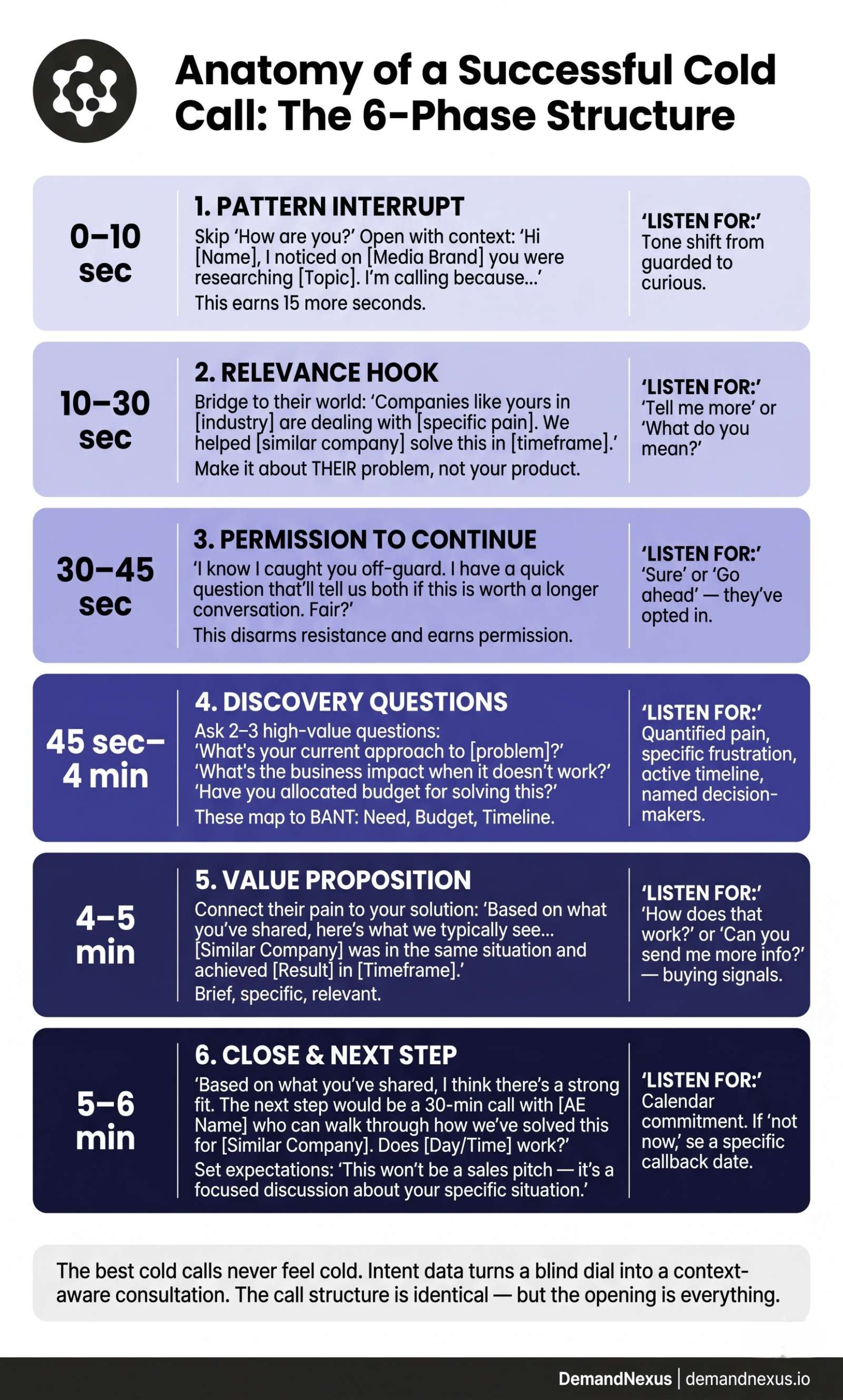
Cold calling outperforms cold emailing in four specific scenarios. First, when targeting senior executives (VP and above). Executive inboxes are flooded; a well-timed, well-researched phone call often cuts through where email does not. Second, when deal sizes are large (above $50,000 ACV). The economics of a phone call are justified by the deal value, and the synchronous conversation allows faster movement to a qualified meeting. Third, when the buying window is urgent. A prospect who is actively evaluating solutions can be qualified and moved to a meeting in a single call. Fourth, when the product requires explanation. Complex enterprise solutions benefit from real-time conversation that email cannot replicate.
When Cold Emailing Works Better
Cold emailing outperforms cold calling in four different scenarios. First, when targeting mid-level buyers (managers, directors) who are more reachable by email than by phone. Second, when deal sizes are smaller (below $25,000 ACV) and the economics do not justify phone time per prospect. Third, when the buyer journey is research-heavy and the prospect needs content before they are ready for a conversation. Fourth, when scaling outbound across a large total addressable market where phone coverage is not feasible. For best practices on cold email delivery and response optimization, see demandnexus.io/cold-email-response-rates/.
The Multi-Touch Cadence: Using Both Together
The highest-performing B2B outbound programs do not choose between cold calling and cold emailing. They sequence both into a multi-touch cadence that uses each channel at the moment it is most effective. A proven cadence structure looks like this: Day 1 is a personalized cold email introducing the relevant business problem. Day 3 is a cold call attempt with a voicemail tied to the email content. Day 5 is a second email with a relevant piece of content or data point. Day 8 is a second cold call attempt. Day 10 is a LinkedIn connection request or engagement. Day 14 is a breakup email that gives the prospect a graceful exit or a reason to re-engage.
This cadence produces significantly higher response rates than either channel alone because each touch reinforces the others. The cold call following an email can reference the email content. The email following a voicemail can reference the voicemail. Multi-touch cadences consistently outperform single-channel approaches by 30-50% on meeting conversion. For cold call voicemail scripts that tie into multi-touch cadences, see demandnexus.io/cold-call-voicemails/. For details on building an effective sales cadence, see demandnexus.io/sales-cadence-b2b/.
How BANT Qualification Applies to Both Channels
Regardless of whether the initial outreach is a cold call or a cold email, the qualification standard should be the same: verified BANT before a meeting is booked. On a cold call, BANT verification happens in real time during the conversation. On a cold email sequence, BANT verification happens when the prospect responds and is then qualified via a follow-up call or a structured reply exchange.
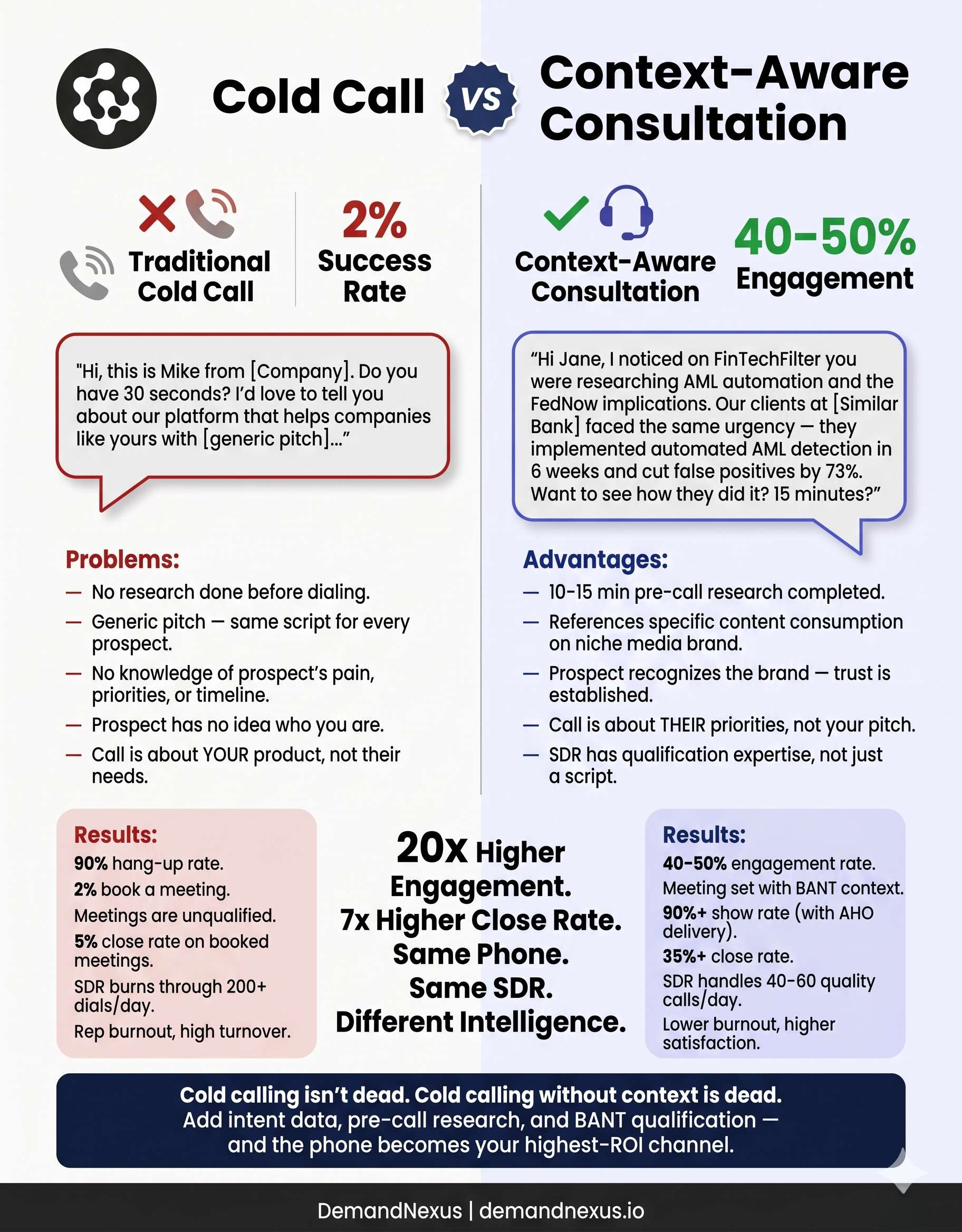
The DemandNexus model applies the same Waterfall qualification standard to both channels. Whether a prospect was first engaged by phone or by email, they must pass ICP match, engagement depth, live BANT verification, and AHO documentation before a meeting is confirmed. This channel-agnostic qualification standard is why our clients see 90%+ show rates and close rates more than 200% higher than non-qualified alternatives, regardless of whether the initial touch was a call or an email.
FAQs
Is cold calling or cold emailing more effective for B2B?
Neither is universally more effective. Cold calling produces faster qualification and works better for senior executives and large deal sizes. Cold emailing scales better and works better for mid-level buyers and smaller deal sizes. The highest-performing programs combine both in a multi-touch cadence that uses each at the moment it is most effective.
What is the response rate for cold calling vs cold emailing?
Cold calling connects on 4-6% of dials with traditional programs achieving a 2.3% meeting rate and intent-driven programs achieving 15-25%. Cold emailing achieves open rates of 25-45% and reply rates of 2-8%. These rates vary significantly with personalization quality, targeting accuracy, and whether intent data is used to prioritize outreach
Is cold calling or cold emailing better for SaaS sales?
For SaaS, the answer depends on segment. Enterprise SaaS with deal sizes above $50,000 ACV benefits heavily from cold calling for the faster qualification cycle. Growth-stage SaaS targeting mid-market can often produce more meetings per dollar through cold email. Most SaaS teams use both in sequence.
How many touches does it take to book a B2B meeting?
Multi-touch cadences combining cold calls, emails, and LinkedIn touches typically require 8-12 touches to book a meeting. Single-channel approaches require more: 200+ dials for cold calling alone, or 8-15 emails for cold email alone. The combined approach outperforms either channel in isolation.
Get More Meetings From Your Outbound Program
If your outbound program is leaning too heavily on one channel, the fix is usually a structured multi-touch cadence with BANT verification on every qualified conversation. To benchmark your current outbound approach, take the qualification diagnostic at demandnexus.io/start-quiz/ or book a strategy call at demandnexus.io/book-a-call.