



This guide covers how to build a B2B content marketing strategy that connects directly to qualified pipeline — not just engagement metrics, traffic, or MQL volume. It covers ICP-first content planning, funnel-stage content mapping, intent signal capture, distribution strategy, measurement, and the structural gap between content engagement and sales-ready conversations that most teams never close.

Most B2B teams lose 40–60% of qualified prospects to broken handoffs and weak qualification. Take our 2-minute diagnostic to find out where your pipeline is bleeding — and how to fix it.
Start the Quiz → Takes 2 minutes. No email required to start.What Is B2B Content Marketing?
B2B content marketing is the creation and distribution of educational, analytical, or opinionated content designed to engage business buyers at different stages of their purchase journey. Unlike B2C content — which often targets individual consumers making fast, emotional decisions — B2B content must serve buying committees of 6–10 stakeholders, address technical and commercial objections simultaneously, and operate across sales cycles measured in months, not days.
The role of content in B2B is threefold: it builds brand authority (so your company appears credible when a buyer begins researching), it captures intent signals (so you know who is actively evaluating), and it creates the context for outbound conversations to land (so SDR outreach references something the prospect genuinely cares about, rather than arriving cold).
When content does all three jobs, it becomes a pipeline asset. When it only does the first — building awareness — it generates traffic, downloads, and MQLs that sales cannot convert. The gap between those two outcomes is where most B2B content marketing investment is lost. Understanding that gap is the starting point for any strategy worth building.

Why Most B2B Content Marketing Strategies Fail to Produce Pipeline
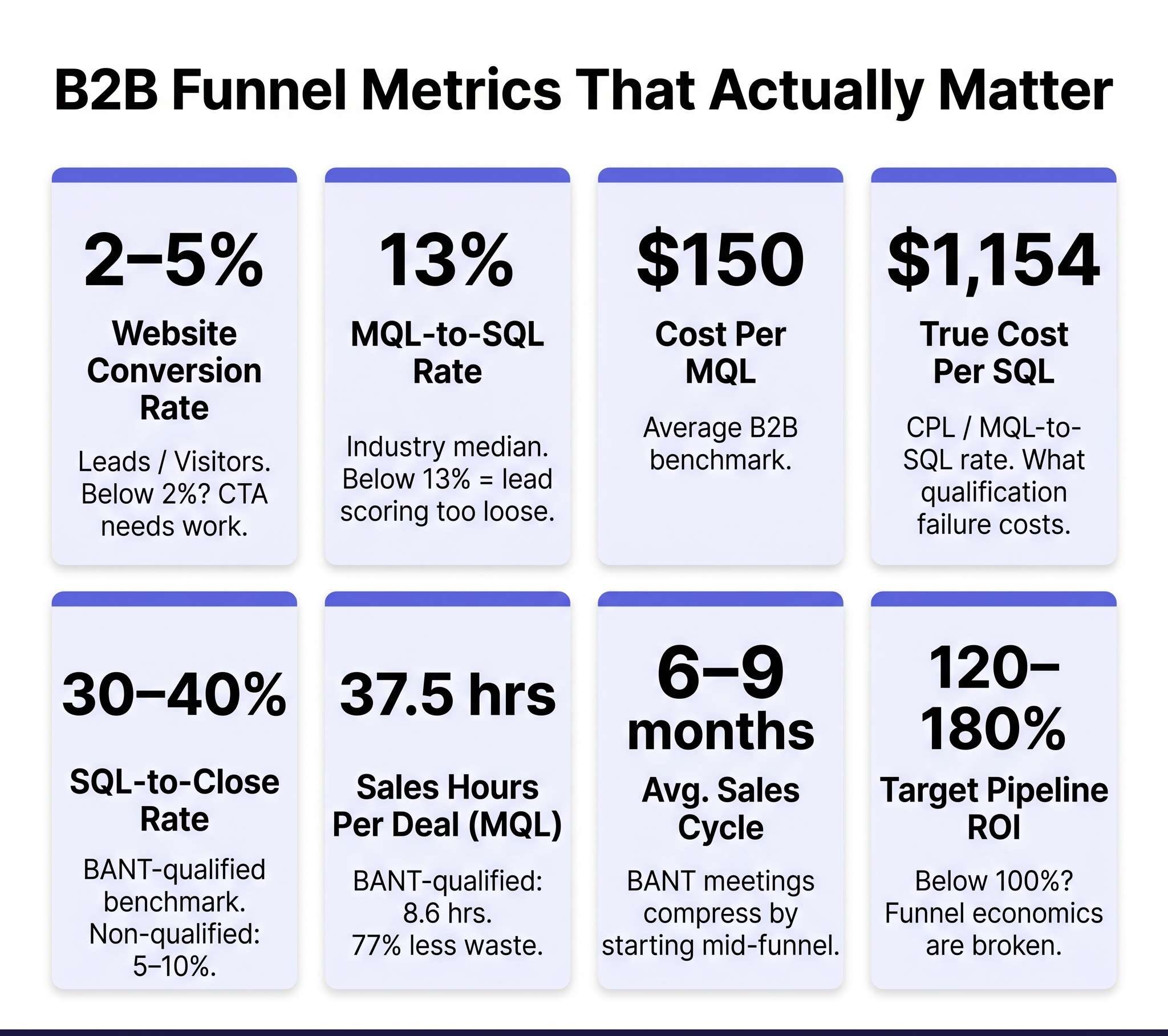
The median MQL-to-SQL conversion rate across B2B organizations is approximately 13%. For every 100 leads that content marketing generates — every whitepaper download, webinar registration, and gated report — 87 will be rejected by sales, go cold, or consume SDR time without ever becoming a real opportunity.
This is not a content quality problem. It is a qualification problem. Content engagement tells you that someone found an asset interesting. It does not tell you whether they have budget allocated, authority to make or influence a purchase decision, an active business need, and a defined timeline. Without those four elements — Budget, Authority, Need, Timeline — a content lead is a name, not a pipeline opportunity.

The B2B marketing challenges that follow from this misalignment are predictable: marketing celebrates hitting content KPIs while sales dismisses the leads as unqualified; pipeline forecasts are built on MQL volume rather than verified buyer intent; and content investment grows without a corresponding improvement in revenue outcomes.
Fixing this requires two changes to how most teams approach content strategy: first, design content to capture qualification signals, not just engagement; second, connect content engagement to a human qualification step before any lead reaches an AE’s calendar.
Step 1: Build Your B2B Content Strategy on ICP Definition, Not Persona Guesswork
Every high-performing B2B content marketing strategy starts with a precise ideal customer profile (ICP). Not a buyer persona built from job title assumptions, but a data-driven definition of the specific companies most likely to buy, stay, and expand — defined by firmographics, technographics, behavioral signals, and revenue fit.
The ICP definition determines every downstream content decision: which topics you cover, which formats you prioritize, which distribution channels you use, and which engagement signals are worth acting on. A content strategy built on a weak ICP produces high traffic and low conversion. A content strategy built on a precise ICP produces lower traffic and significantly higher pipeline quality.
ICP definition for content strategy purposes should cover:
- Firmographics: company size, industry vertical, revenue range, geography, and org structure (do they have the team that would use your product?)
- Technographics: current tech stack, point solutions they are likely replacing, integration requirements that your product satisfies
- Buying triggers: events that create urgency — funding rounds, headcount growth, contract renewals, regulatory changes, competitive pressure
- Content consumption patterns: what formats your ICP engages with, which topics indicate active research, which publications they trust
- Decision-making structure: how many stakeholders are involved, who the economic buyer is, what the approval process looks like
The last point is particularly important for content strategy: if your ICP involves buying committees of 5+ people, your content needs to address multiple stakeholder concerns simultaneously — not just the persona of the person most likely to download a whitepaper.
Step 2: Map Content to Buyer Journey Stages — Including a Qualification Layer
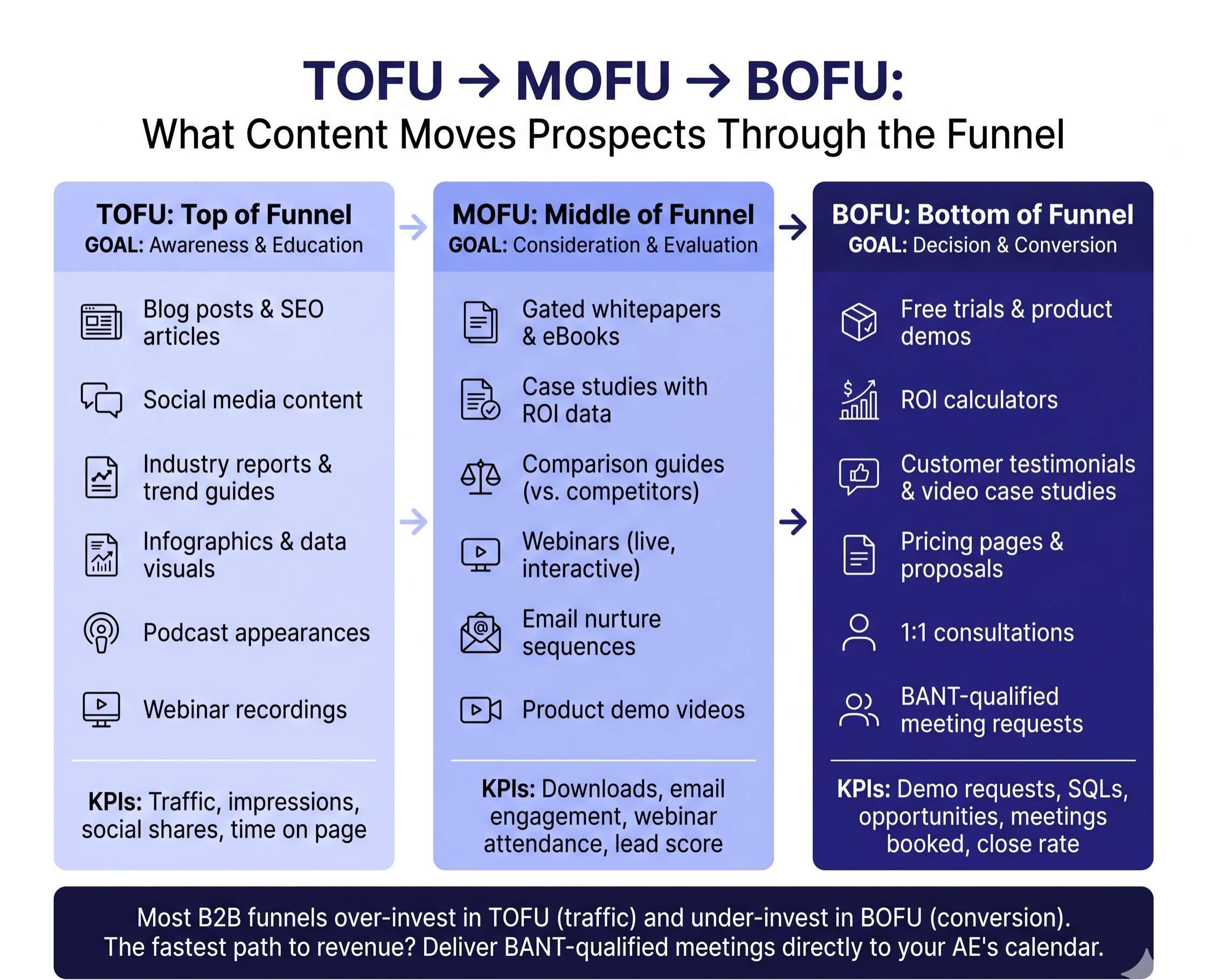
Most B2B content frameworks map assets to awareness, consideration, and decision stages of the buyer journey. That structure is correct but incomplete. The missing layer is qualification: at which stage of content engagement is a prospect signaling genuine buying intent, and what happens when they cross that threshold?
Top-of-Funnel: Awareness Content
Awareness content builds recognition and authority with your ICP. It should rank for the topics your buyers research early in their problem-definition phase and should position your brand as a credible source before they begin evaluating vendors.
Effective TOFU content for B2B:
- Pillar pages and long-form guides covering the problems your ICP is trying to solve
- Original research and industry benchmarks (proprietary data is the highest-authority TOFU format)
- Educational blog posts and thought leadership that address industry trends without being product-led
- SEO-optimized explainer content targeting the informational queries your ICP uses when beginning to research
TOFU engagement — a blog visit, a social share, a newsletter sign-up — is an awareness signal, not a qualification signal. Do not pass TOFU-engaged contacts to sales. Do capture them for nurture and track whether their engagement deepens over time.
Middle-of-Funnel: Consideration Content
MOFU content engages prospects who have defined their problem and are now evaluating approaches. This is where qualification signals first appear: a prospect who downloads a solution comparison guide, attends a category-specific webinar, or repeatedly returns to your pricing page is demonstrating active evaluation behavior.
Effective MOFU content for B2B:
- Vendor comparison guides and category-specific frameworks
- Webinar series addressing the specific use cases your ICP is evaluating (attendance and engagement level are strong intent signals)
- Gated research reports where the download topic reveals the prospect’s specific problem area
- Case studies from companies with a profile similar to the prospect’s — same industry, similar company size, analogous challenge
- ROI calculators and self-assessment tools that collect qualification-relevant data while delivering immediate value
MOFU is where intent-based marketing becomes decisive. A prospect who downloads your ROI calculator is telling you their approximate budget range and what outcome they are trying to justify. A prospect who attends a webinar on migrating away from a specific competitor is telling you what they currently use and that they are actively evaluating alternatives. These are qualification signals, not just engagement signals — and they should trigger prioritized outreach, not automated nurture sequences.
Bottom-of-Funnel: Conversion Content
BOFU content serves prospects who are in active vendor evaluation. At this stage, content’s job is to remove objections, provide social proof, and create urgency — while the qualification process ensures that every AE conversation is with someone who has confirmed budget, authority, need, and timeline.
Effective BOFU content for B2B:
- Customer success stories with quantified outcomes (specific numbers, not vague claims)
- Security, compliance, and legal documentation for enterprise buyers
- Implementation roadmaps and onboarding guides that answer “what does this look like after we sign?”
- Competitive displacement content for prospects currently using an alternative — see B2B sales lead generation services for displacement-specific campaign approaches
Step 3: Use Content to Capture First-Party Intent Signals
Content engagement is valuable not just for what it produces (traffic, MQLs, brand awareness) but for what it reveals about buyer intent. The difference between a B2B content strategy that produces pipeline and one that produces vanity metrics is whether you have a system for capturing, interpreting, and acting on the intent signals that content engagement generates.
First-party intent signals — engagement from known individuals with your own content, collected directly rather than inferred from third-party sources — are the most accurate and actionable signals available. They tell you who engaged, what they engaged with, and when, without the inference errors and data lag that characterize third-party intent products.
The content assets that generate the strongest first-party intent signals in B2B:
| Content Asset | Intent Signal Generated | Qualification Implication |
|---|---|---|
| Gated research report | Topic of download = problem the prospect is actively researching | SDR outreach should reference the specific topic and ask about their current approach |
| Webinar attendance | Live attendance (vs. registration) = significantly stronger signal; Q&A participation = strongest signal | Prioritize live attendees who submitted questions for immediate follow-up |
| ROI calculator | Input data reveals budget range, current spend, and desired outcome | Prospect has self-identified budget context; SDR can confirm and qualify against BANT |
| Pricing page (3+ visits in 30 days) | Repeated return to pricing = active evaluation, not casual browsing | High-priority signal; should trigger same-day outreach |
| Case study from same industry | Prospect is mapping your outcomes to their situation | SDR outreach should reference the specific case study and ask about their analogous challenge |
| Newsletter click-through to solution content | Active subscriber clicking to product-relevant content = deepening interest | Track click patterns over time; rising frequency = escalating intent |
DemandNexus captures first-party intent signals at scale through six owned B2B media brands — AITechTrend, MarTechTrend, HRTechTrend, FinTechFilter, LegalTechTrend, and DevTechTrend — reaching 15M+ decision-makers. When a named decision-maker engages with content on these properties, the signal identifies them by name, title, company, and specific topic — enabling outreach that references their actual research behavior rather than demographic assumptions. This is fundamentally different from third-party intent data, which reports anonymous IP-level signals inferred from aggregated browsing.
Step 4: Connect Content Strategy to Your Demand Generation Framework
B2B content marketing does not exist in isolation — it should be a core input to your B2B demand generation engine. Content creates the conditions for demand generation to work: it builds brand familiarity with your ICP before outbound contact, provides SDRs with conversation starters that reference real prospect interests, and generates the intent signals that prioritize which accounts to contact and when.
A demand generation framework that integrates content effectively treats content engagement as a qualification input, not a standalone deliverable. The sequence looks like this:
- Content creates awareness and captures intent: ICP-fit prospects engage with content assets; signals are logged by named individual where possible, account-level where not
- Intent signals prioritize outreach targets: SDRs and the demand gen team use content engagement data to rank target accounts by readiness — a company where 3 people have downloaded your whitepaper and attended a webinar is higher priority than one with zero content engagement
- Outbound sequences reference content engagement: SDR outreach opens with the specific content the prospect engaged with, immediately establishing relevance and differentiating the call from generic cold contact
- Qualification confirms buying readiness: A live discovery call verifies BANT criteria before any meeting is booked with an AE — budget, authority, need, and timeline are all confirmed, not assumed from engagement scoring
- AE meeting is preceded by an Appointment Handover Sheet (AHO): the AE receives full pre-meeting intelligence on the prospect’s content consumption, stated pain points, decision-making structure, budget status, and competitive landscape before the first call
This is the integration point between demand generation content and revenue-producing pipeline. Content that feeds this sequence is a pipeline asset. Content that does not is a marketing expense.
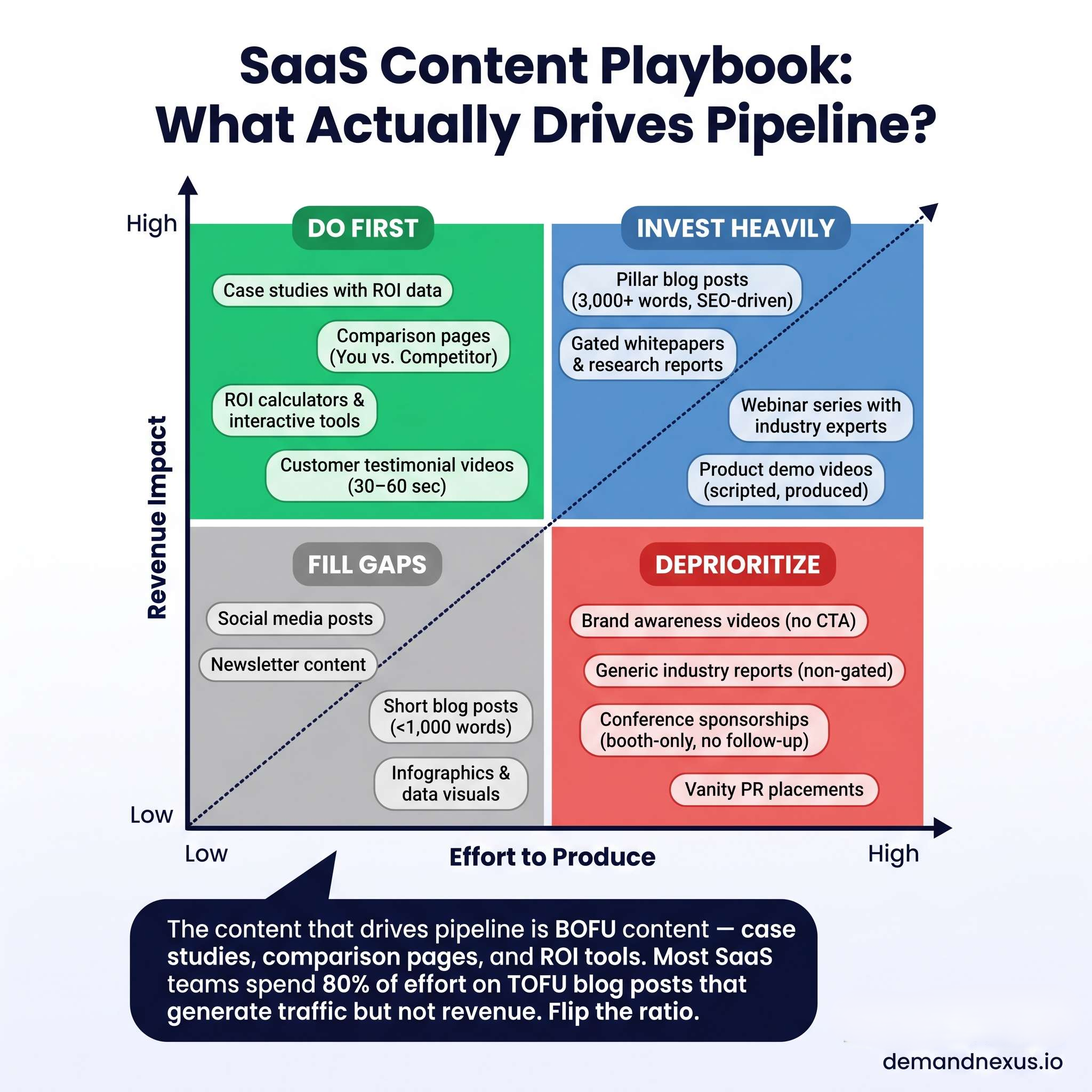
Step 5: Prioritize Content Types by Pipeline Impact, Not Just Engagement
Not all content formats contribute equally to pipeline. High-traffic blog posts may build brand awareness but produce low-intent visitors. A single well-executed webinar for a specific ICP segment may produce dozens of qualified conversations. The right content mix depends on your stage of growth, your ICP’s content preferences, and your distribution infrastructure.
Here is how to evaluate content types by their pipeline contribution:
| Content Type | Funnel Stage | Intent Signal Strength | Pipeline Contribution |
|---|---|---|---|
| Original research / industry report | TOFU-MOFU | Medium (topic-level) | High — drives backlinks, media coverage, and gated engagement |
| Gated whitepaper / guide | MOFU | Medium-High | Medium-High — strong topic signal; requires follow-up qualification |
| Webinar (live + on-demand) | MOFU | High (attendance + Q&A) | High — live attendees are strong pipeline candidates when followed up same-day |
| Case study (industry-specific) | MOFU-BOFU | High | High — BOFU engagement; prospects mapping outcomes to their own situation |
| ROI / assessment tool | MOFU-BOFU | Very High | Very High — self-qualification; prospect reveals budget context and desired outcome |
| SEO blog post | TOFU | Low-Medium | Medium — builds awareness and ICP-fit traffic; low direct pipeline contribution |
| Email newsletter | All stages | Medium (click behavior) | Medium — repeated clicks to solution content indicate rising intent |
| LinkedIn thought leadership | TOFU-MOFU | Low-Medium | Low-Medium — builds familiarity; most valuable for warming cold outreach |
For SaaS demand generation, the highest-ROI content investment is typically the combination of original research (TOFU) and vertical-specific webinars (MOFU), with ROI calculators (BOFU) capturing the self-qualification signal that prioritizes which leads receive immediate human follow-up.
Step 6: Distribute Content Through Channels That Reach Your ICP Directly
Creating great content and distributing it through owned channels is necessary but not sufficient for most B2B companies. Building organic traffic takes 6–12 months. LinkedIn organic reach has declined significantly. Email lists take years to build at meaningful scale. For B2B organizations that need pipeline in the next 90 days, owned distribution alone is not the answer.
The highest-leverage B2B content distribution strategy combines owned channels (your blog, email list, LinkedIn presence) with partner channels that already aggregate your ICP at scale. Niche B2B media brands — publications serving a specific industry vertical with trusted editorial content — are particularly valuable because their audiences are pre-qualified by industry, opted in, and actively engaged with content about the problems you solve.
Effective B2B content distribution channels, ranked by ICP precision:
- Owned media — first priority: your website, email list, and LinkedIn. Highest margin; slowest to scale. Requires 6–18 months of consistent investment before generating meaningful pipeline volume.
- Niche industry media brands — highest ICP precision: vertical publications (e.g., FinTechFilter for fintech buyers, MarTechTrend for marketing leaders) where the audience is pre-qualified by industry and has opted in to content about your category. First-party intent data from these properties is the most reliable signal available.
- Webinar co-hosting — strong for MOFU: partnering with a trusted industry platform to run a webinar series generates attendance from warm, engaged audiences who self-select based on topic relevance. Post-webinar intent signals are significantly stronger than typical content engagement.
- Content syndication — use selectively: broad syndication networks can extend reach but often produce low-intent contacts. Choose syndication partners who provide first-party contact data (name, title, company, specific content engaged) rather than anonymous IP signals.
- LinkedIn paid distribution — useful for ICP targeting: LinkedIn’s targeting precision is unmatched for reaching specific job titles at specific company sizes, but CPL is high ($50-200+) and most LinkedIn leads are TOFU at best. Use for content promotion, not direct pipeline generation.
For organizations expanding into new markets, B2B international business expansion content strategy requires distribution through locally trusted channels — the same content distributed through a US-focused publication will not reach decision-makers in EMEA or APAC markets with the same relevance or authority.
Step 7: Measure B2B Content Marketing with Metrics That Predict Revenue
Most B2B marketing metrics frameworks stop at engagement: sessions, downloads, MQLs, webinar registrants. These metrics are worth tracking for diagnostic purposes — they help you understand what content is resonating with your audience. But they should never be reported as evidence of pipeline contribution, because engagement and buying intent are not the same thing.
The content marketing metrics that predict pipeline:
| Metric | What It Actually Measures | Why It Predicts Pipeline |
|---|---|---|
| ICP-fit organic sessions | % of organic visitors matching your ideal customer profile | Traffic quality; eliminates vanity metric inflation from off-ICP visitors |
| Content-influenced pipeline | Revenue in opportunities where a content asset was consumed before the sales conversation | Directly links content investment to deals; accounts for long attribution windows |
| Download-to-conversation rate | % of gated content downloads that convert to an SDR conversation | Reveals which assets attract in-market buyers vs. researchers with no buying intent |
| Content-to-qualified-meeting rate | % of content-engaged contacts who become BANT-verified appointments | The definitive pipeline contribution metric; connects content engagement to verified buyers |
| Returning named account visit rate | % of target accounts visiting 2+ times in 30 days | Rising research intensity from a target account = escalating intent; trigger for outreach prioritization |
| Webinar attendance-to-pipeline | % of live webinar attendees who become pipeline opportunities within 90 days | Measures the most reliable MOFU content format against its actual pipeline contribution |
Connect these metrics to your demand generation metrics dashboard so content performance is always measured against the same revenue benchmarks as every other pipeline-generating activity. Content that produces ICP-fit engagement but zero pipeline contribution should be deprioritized regardless of its traffic numbers.
Step 8: Connect Content Engagement to B2B Lead Generation and Qualification
The final — and most commonly missed — step in a B2B content marketing strategy is the connection between content engagement and the qualification process that produces sales-ready meetings. Without this connection, content marketing is a brand-building exercise. With it, content marketing is a pipeline engine.
Effective B2B prospecting in 2026 uses content engagement as a trigger, not just a tracking data point. When a named decision-maker at a target account downloads a specific whitepaper, attends a webinar, or returns to your pricing page three times in a week, that signal should trigger a prioritized outreach sequence within 24 hours — while the context is active and the prospect is in research mode.
That outreach sequence should reference the specific content the prospect engaged with, establishing immediate relevance. It should be designed to book a qualification call, not a sales demo. And the qualification call should verify BANT criteria — Budget, Authority, Need, Timeline — before any meeting with an AE is scheduled. This is how B2B sales lead generation connects to content strategy at the operational level.
The metrics that govern this connection — how many content-engaged contacts convert to BANT-qualified meetings, at what cost, and with what downstream close rate — are covered in the sales lead generation KPIs framework and the B2B marketing pipeline measurement guide.
B2B Content Marketing vs. Demand Generation: How They Work Together
Content marketing and demand generation vs. growth marketing and ABM are frequently treated as competing strategies when they are actually complementary disciplines. The distinction matters for how you resource them, measure them, and integrate them into a unified revenue engine.
| Dimension | B2B Content Marketing | B2B Demand Generation |
|---|---|---|
| Primary goal | Build awareness, authority, and organic discovery among ICP | Create and qualify pipeline opportunities at scale |
| Time horizon | 6-18 months for significant organic pipeline contribution | 30-90 days from campaign launch to first meetings |
| How it produces pipeline | By capturing intent signals from content-engaged buyers and feeding them to a qualification process | By identifying in-market accounts and initiating outbound contact with BANT verification |
| What it measures | ICP-fit traffic, content-influenced pipeline, download-to-conversation rate | BANT-qualified appointments, cost per meeting, AE close rate |
| How DemandNexus integrates both | Content engagement signals from 6 owned media brands trigger prioritized outbound sequences; qualification converts intent signals into BANT-verified appointments | The Waterfall Model uses first-party intent as Stage 1 input; human BANT verification converts signals to pipeline |
The most effective B2B revenue organizations treat content marketing as the top of their demand generation engine — not as a separate function. Content creates the conditions (awareness, intent signals, conversation context) that demand generation converts into qualified pipeline. Neither works as well in isolation as it does when integrated. See the full what is demand generation guide for how DemandNexus structures this integration.
Ready to Turn Content Engagement Into Qualified Pipeline?
DemandNexus captures first-party intent signals from 15M+ decision-makers across six owned B2B media brands, then converts those signals into BANT-qualified appointments delivered directly to your AE’s calendar. Every meeting includes a completed Appointment Handover Sheet with full pre-meeting intelligence. You pay only for meetings that show up and meet your qualification criteria.
See how we integrate content intent with pipeline qualification for B2B companies by contacting us at sales@demandnexus.io.
FAQs
What is B2B content marketing?
B2B content marketing is the creation and distribution of educational, analytical, or insight-driven content designed to engage business buyers at different stages of their purchase journey. Unlike B2C content, B2B content marketing must address buying committees of multiple stakeholders, operate across long sales cycles, and generate both brand awareness and qualified buying signals. When done effectively, it creates the conditions for outbound conversations to land with relevant context and for intent signals to trigger prioritized qualification outreach.
What is a B2B content marketing strategy?
A B2B content marketing strategy is a structured plan for creating, distributing, and measuring content to advance specific business objectives — primarily pipeline generation and revenue growth. It covers ICP definition, content mapping to buyer journey stages, intent signal capture, distribution channel selection, qualification integration, and performance measurement against pipeline metrics rather than vanity metrics.
How does B2B content marketing connect to demand generation?
B2B content marketing creates the awareness and intent signals that B2B demand generation converts into qualified pipeline. Content builds brand familiarity with your ICP before outbound contact, provides SDRs with conversation context referencing real prospect interests, and generates the first-party intent signals that prioritize which accounts to contact and when. Without content, demand generation starts cold. Without demand generation's qualification process, content produces traffic but not revenue.
What content types work best for B2B lead generation?
The content types that produce the strongest intent signals for B2B sales lead generation are: gated research reports (topic-level qualification signal), live webinars (attendance and Q&A are strong MOFU signals), ROI calculators (self-qualification with budget context), industry-specific case studies (BOFU evaluation signal), and repeated visits to solution or pricing pages (highest-priority intent signal). TOFU content like blog posts and social content builds awareness but rarely produces direct pipeline without a qualification step downstream.
How do you measure B2B content marketing ROI?
B2B content marketing ROI should be measured against pipeline contribution, not just engagement. The key metrics are: content-influenced pipeline (revenue in opportunities where content was consumed before the sales conversation), content-to-qualified-meeting rate (% of content-engaged contacts who become BANT-verified appointments), ICP-fit organic traffic (% of sessions from visitors matching your ideal customer profile), and download-to-conversation rate. Detailed benchmarks are in the B2B marketing metrics guide.
What is the role of intent data in B2B content marketing?
Intent data reveals which prospects are actively researching solutions like yours — making it the bridge between content engagement and qualified outreach. First-party intent data, collected from your own content and owned media properties, is the most accurate form because it identifies named individuals (not anonymous IP addresses) engaging with specific content topics in real time. Intent-based marketing uses these signals to prioritize outreach, personalize SDR conversations, and ensure that qualification effort is concentrated on the accounts most likely to be in an active buying cycle.
How does a B2B content marketing strategy differ for SaaS companies?
For SaaS demand generation, content marketing has an additional job: educating the market about the category, not just the product. SaaS buyers often need to understand why a category of solution addresses their problem before they can evaluate specific vendors. The highest-ROI content investment for B2B SaaS is typically original research (builds category authority and generates backlinks), vertical-specific webinars (produces strong MOFU intent signals), and ROI calculators (enables self-qualification with budget context). Product-led content like comparison guides and G2 review campaigns become important as deals move to BOFU.
What B2B content marketing KPIs should I track in 2026?
The B2B content marketing KPIs that predict pipeline contribution are: content-influenced pipeline, content-to-BANT-qualified-meeting rate, ICP-fit traffic %, download-to-conversation rate, and returning target account visit rate. For a full breakdown of how these connect to revenue outcomes, see the demand generation metrics guide and the sales lead generation KPIs framework.