

This playbook is for teams building or upgrading a B2B cold calling function. We cover who should run it, how to target the right accounts, how to build the right list, the right cadence, the right tech stack, the right team structure, and the metrics that actually matter. Think of this as the complete strategic framework, not a tactical script dump.

Most B2B teams lose 40–60% of qualified prospects to broken handoffs and weak qualification. Take our 2-minute diagnostic to find out where your pipeline is bleeding — and how to fix it.
Start the Quiz → Takes 2 minutes. No email required to start.Who Should Run B2B Cold Calling
Three viable models: dedicated SDR team inside your company, a managed outsourced partner, or a hybrid where you run 1 to 2 internal reps and augment with outsourced volume. The right choice depends on your size, your deal complexity, and how much control you need.
- Dedicated internal SDR team: best for companies over $10M ARR with complex enterprise sales.
- Outsourced partner: best for companies under $10M ARR or for testing new markets without hiring.
- Hybrid: best for $5M to $20M ARR companies balancing control with speed.
ICP Targeting: The Foundation Nobody Does Well
The single biggest lever in B2B cold calling performance is ICP precision. A call to a perfectly-fit prospect books a meeting at 5 to 10 times the rate of a call to a marginal-fit prospect. Yet most teams define ICP loosely and wonder why their conversion is low.
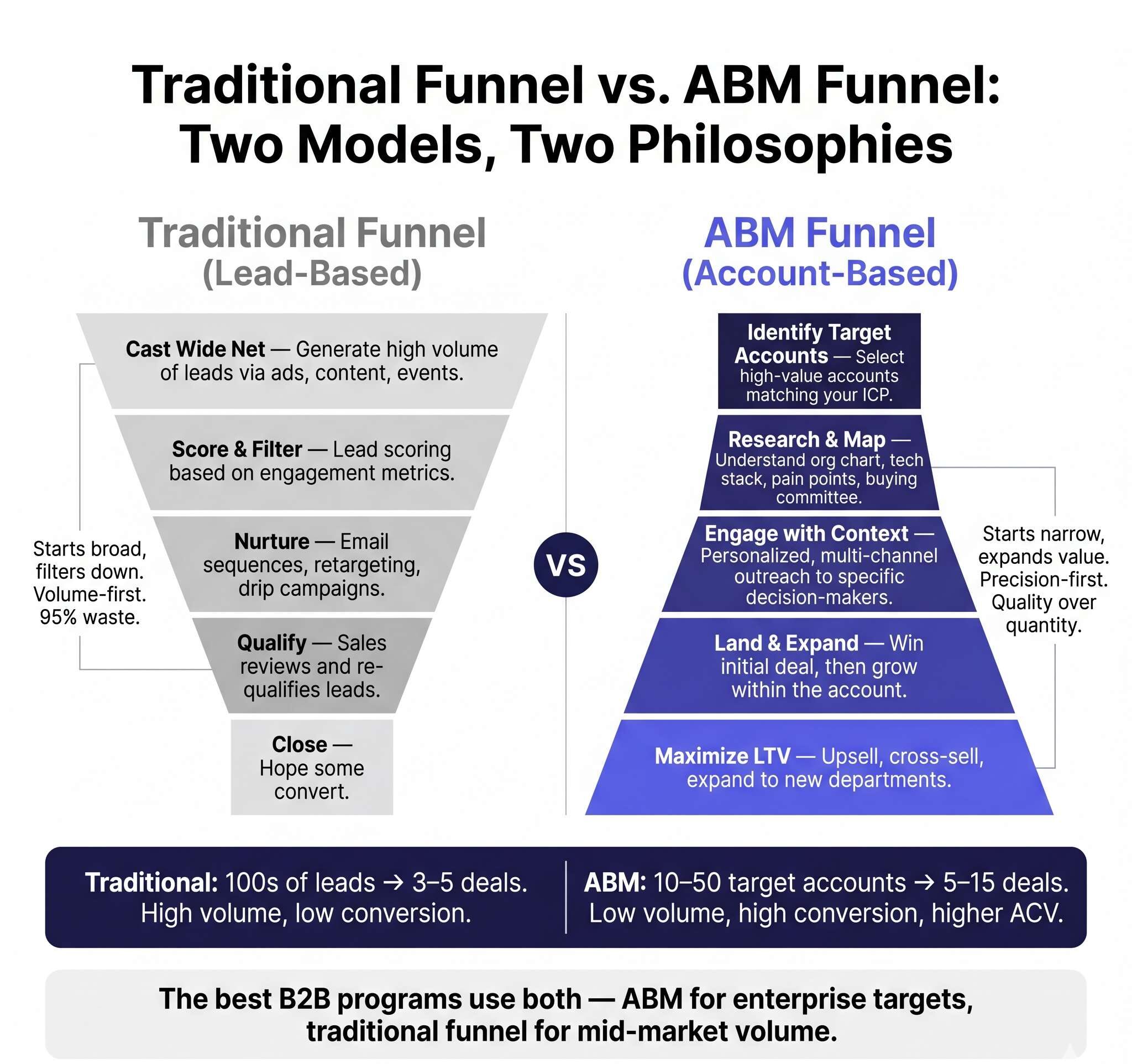
A tight B2B ICP definition includes firmographics (industry, company size, revenue, geography), technographics (tech stack), buyer role (specific titles, not job families), trigger events (funding, growth signals), and negative criteria (who you explicitly do not sell to). Write this down. Share it with the calling team. Refuse to dial contacts who do not fit.
Building the Right B2B List
For B2B, we strongly prefer smaller high-quality lists over larger generic lists. 500 perfectly-fit prospects outperform 5,000 marginal ones every time.

- Start with a firmographic filter in Apollo, ZoomInfo, or LinkedIn Sales Navigator matching your tight ICP.
- Layer trigger event data: recent funding, hiring patterns, leadership changes, tech stack changes.
- Pull 1 to 3 specific people per account whose role maps directly to the problem you solve.
- Enrich with direct-dial numbers (not switchboards).
- Scrub against all applicable do-not-call registries.
- Verify a 5 percent sample manually before dialing the full list.
Cadence Design: Multi-Touch Beats Single Channel
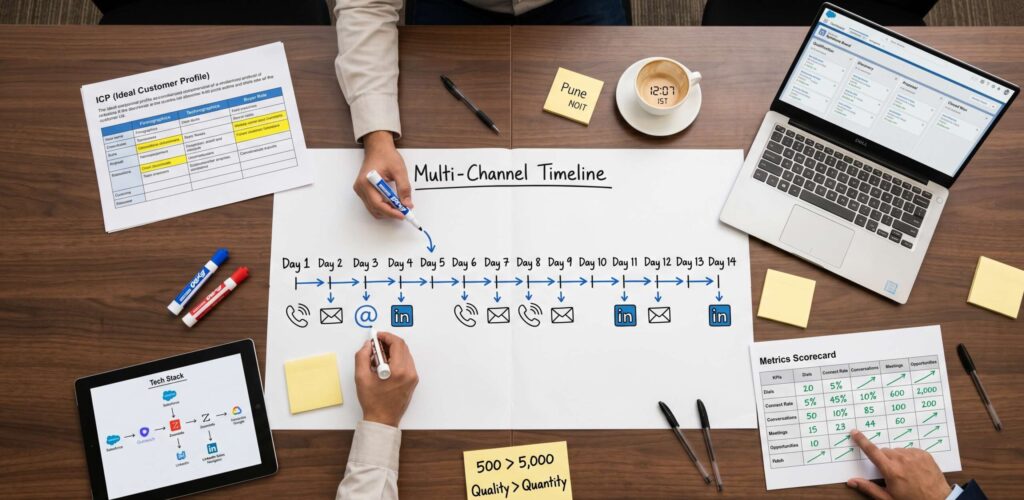
A pure cold call cadence is obsolete. The modern B2B cadence blends calls with email and LinkedIn touches to reach the prospect on their preferred channel. Our recommended 14-day sequence:
- Day 1: Connect on LinkedIn with a personalized note.
- Day 2: Cold call (first attempt).
- Day 3: Cold email following up on call.
- Day 5: Cold call (second attempt, different time of day).
- Day 7: LinkedIn message referencing call and email.
- Day 9: Cold call (third attempt).
- Day 11: Value-add email (share relevant case study or insight).
- Day 14: Final call plus breakup email.
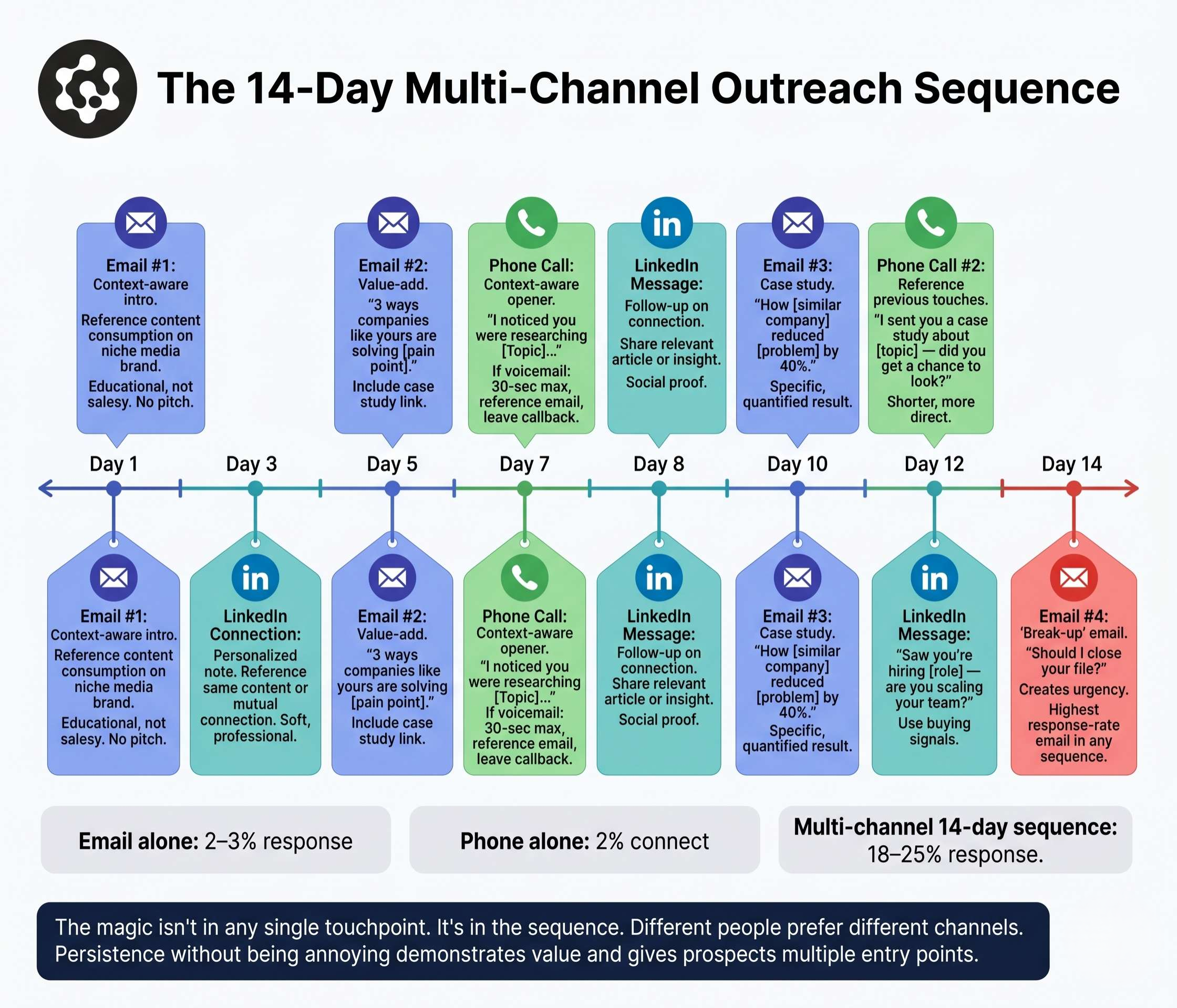
Prospects who do not respond across 8 touches in 14 days are almost certainly never going to respond. Move on and revisit in 90 days with new trigger data.
The B2B Cold Calling Tech Stack
- CRM: Salesforce, HubSpot, or Pipedrive (depending on company size).
- Data: Apollo, ZoomInfo, or both for complementary coverage.
- Dialer: Orum, Nooks, or Kixie depending on volume needs.
- Sales engagement: Outreach, Salesloft, or Apollo’s built-in sequencer.
- Call recording and coaching: Gong, Chorus, or built into the dialer.
- Calendar scheduling: Calendly or Chili Piper for round-robin booking.
- Enrichment and research: Clay for custom AI-powered lookups.
For a 5-rep SDR team, expect $15,000 to $30,000 per month in software total. If that seems high, it is cheaper than the salary of a single additional SDR.
Team Structure: Who Does What
Modern B2B cold calling teams separate roles rather than asking one person to do everything. Common structure:
- SDR (Sales Development Rep): runs outbound prospecting, books meetings.
- AE (Account Executive): takes meetings, runs the sales process, closes deals.
- Sales Ops: owns tools, data, and reporting.
- Sales Manager or SDR Lead: coaches, reviews calls, runs 1:1s.
- Marketing Ops: owns list data and trigger events.
Metrics That Actually Matter
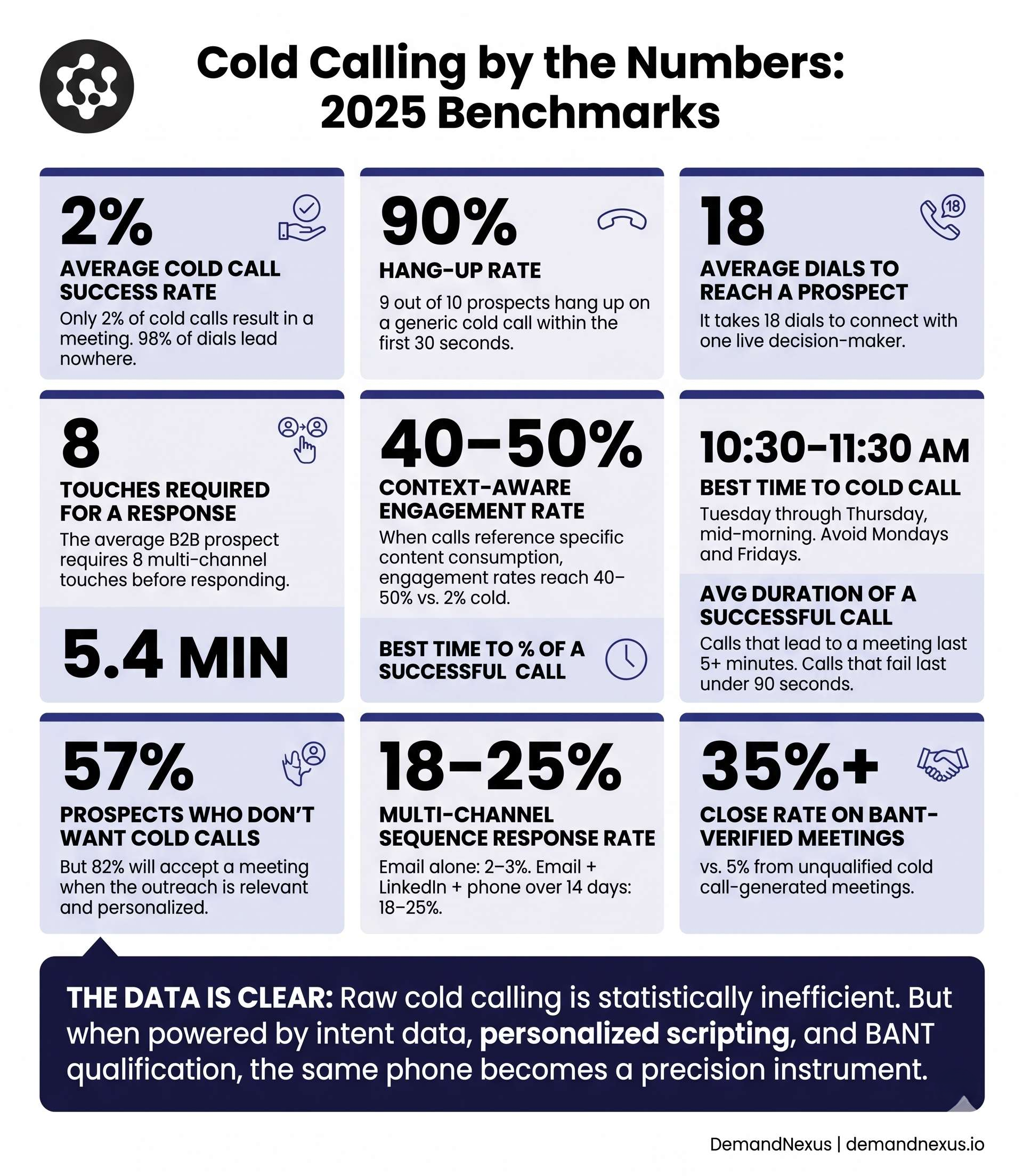
| Metric | What It Tells You | B2B Benchmark |
| Dials per day per rep | Activity level | 80 to 120 (with dialer) |
| Connect rate | List quality and timing | 5 to 10 percent |
| Conversation to meeting | Pitch quality | 20 to 40 percent |
| Meeting show rate | Meeting quality | 70 to 85 percent |
| Meeting to opportunity | Fit and qualification | 30 to 50 percent |
| Opportunity to close | Sales process strength | 15 to 30 percent |
| Cost per meeting | Efficiency | $150 to $400 |
Common B2B Cold Calling Mistakes
- Calling before the ICP is tight: leads to wasted dials and discouraged reps.
- Treating cold calling as a standalone channel: missing the multi-touch uplift.
- Measuring only meetings booked, not show rate or fit: creates bad incentives.
- Letting reps pick their own lists: people will avoid the hardest accounts.
- No call recording or coaching: same mistakes repeated daily.
- Too many dialers and tools: context-switching kills productivity.
- Confusing SDR and AE roles: closes suffer when AEs prospect, pipeline suffers when SDRs close.
Scaling a B2B Cold Calling Program
Scaling cold calling goes through predictable phases. Phase 1 (1 to 2 reps): prove the motion works and write down the playbook. Phase 2 (3 to 5 reps): systematize onboarding, coaching, and reporting. Phase 3 (6 to 15 reps): add SDR management layer, formalize territory and list assignments. Phase 4 (15+ reps): specialize by segment and add sales operations headcount. Most teams break between phases 2 and 3 because they did not document the playbook clearly enough to onboard new reps fast.
How DemandNexus Helps B2B Teams
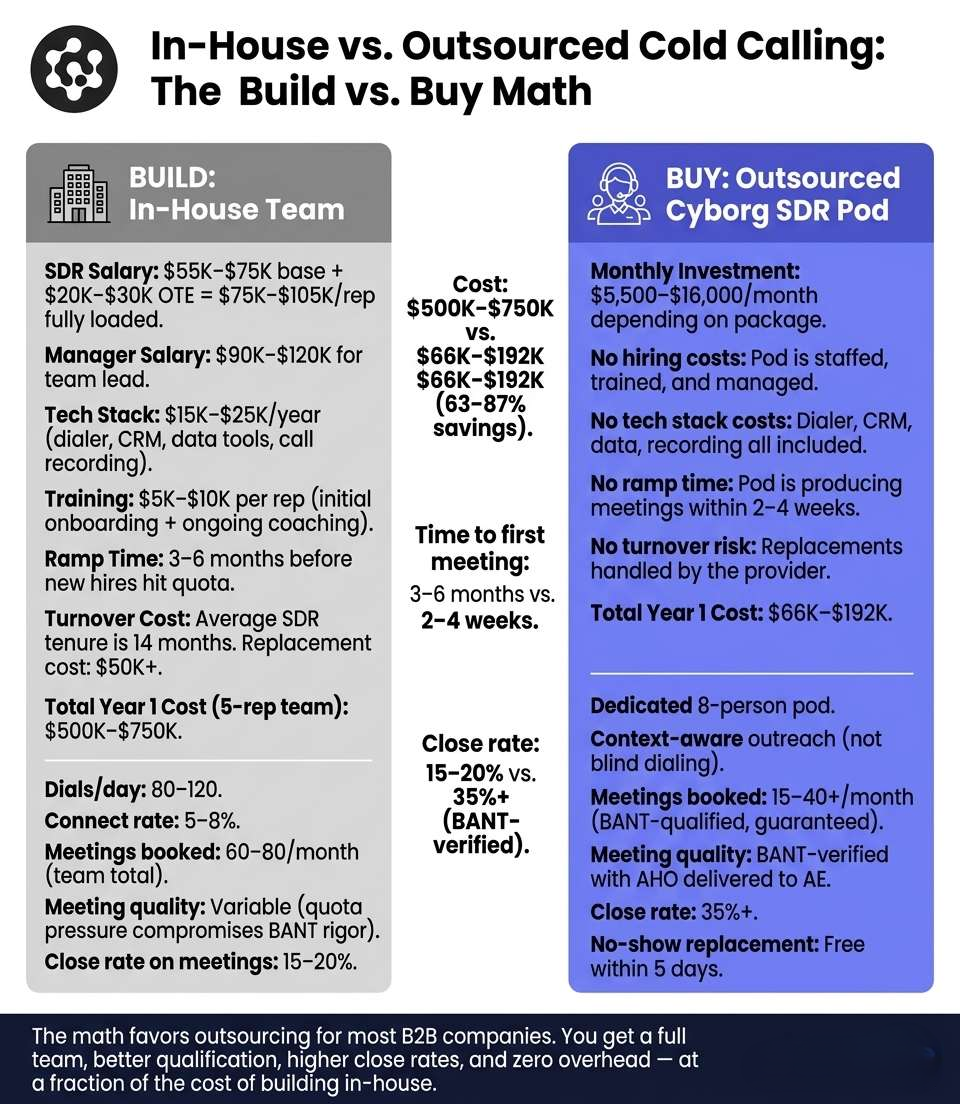
DemandNexus provides the full B2B cold calling stack as a managed service: list building, tech stack, trained callers, coaching, and reporting, all under one monthly fee. Clients get phase 2 results without the phase 1 learning curve. See our B2B cold calling services page for current packages.
FAQs
What is the best B2B cold calling cadence?
Our tested cadence: 8 touches across call, email, and LinkedIn over 14 days. Prospects who do not respond by touch 8 almost never respond.
How many dials per day should a B2B SDR make?
With a modern dialer, 80 to 120 dials per day is sustainable and produces 4 to 8 conversations per day. Without a dialer, cut those numbers in half.
Does cold calling still work for enterprise B2B sales?
Yes. Enterprise buyers are harder to reach but deal sizes justify the effort. Most enterprise sales organizations still report 15 to 30 percent of pipeline sourced from cold outbound.